
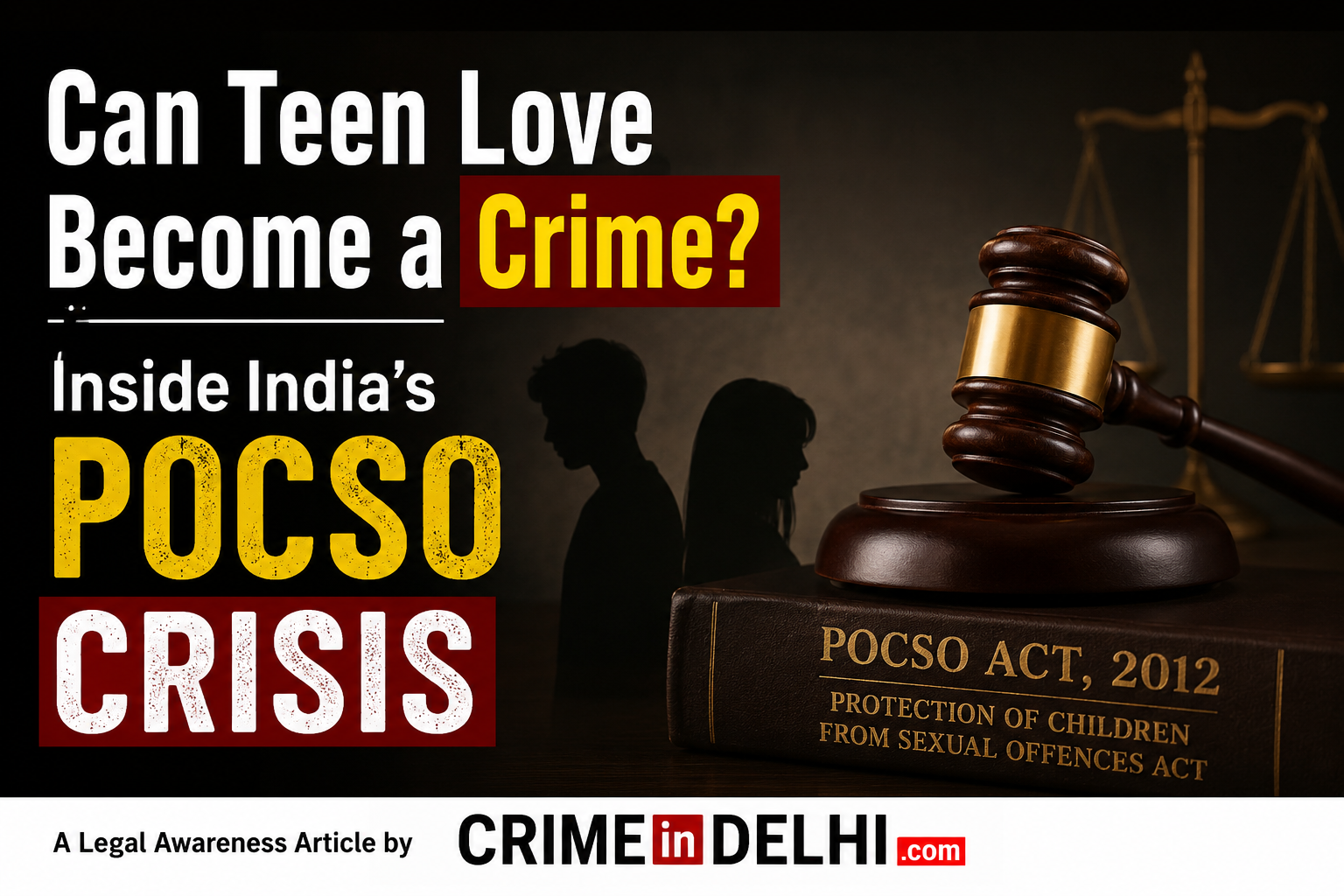
A teenage girl stands in a courtroom and tells the judge that she was in love. She says she left home willingly. She says nobody forced her into the relationship. Yet the boy beside her faces charges of kidnapping, rape, and offences under the Protection of Children from Sexual Offences Act, commonly known as POCSO.
This situation no longer shocks Indian courts. Judges across the country now regularly hear cases involving consensual teenage relationships. In many matters, the girl herself denies any abuse. However, the criminal case continues because Indian law does not recognize consent below eighteen years of age.
The debate around India’s age of consent law now reaches far beyond courtrooms. Lawyers, psychologists, activists, and researchers across the world discuss the issue. The reason is simple. India must balance child protection with the social reality of adolescent relationships.
What Is the POCSO Act?
India enacted the POCSO Act in 2012 to protect children from sexual abuse, exploitation, and harassment. The law treats every person below eighteen years as a child.
The Act follows a strict principle. A minor cannot legally consent to sexual activity. Therefore, even a voluntary relationship may attract criminal charges if one person is below eighteen years of age.
Lawmakers created the legislation to protect children from predators and exploiters. However, courts increasingly see cases involving romantic relationships between teenagers instead of violent abuse.
This trend has created serious legal and constitutional questions.
Courts Have Raised Concerns
Indian courts have repeatedly acknowledged this growing problem.
One important observation came from the Madras High Court in Sabari v. Inspector of Police. The Court discussed how consensual adolescent relationships often turn into criminal prosecutions under POCSO. The judgment recognized that many such relationships arise from emotional attraction between teenagers rather than predatory conduct.
The Court also warned against treating every adolescent relationship like a violent sexual offence.
Similarly, the Delhi High Court has expressed concern in several matters involving consensual relationships. In many cases, parents object to the relationship and approach the police. Once authorities register an FIR under POCSO, the prosecution usually continues even when the girl supports the accused before the Court.
These cases reveal a difficult conflict between statutory law and social reality.
Family Pressure and Social Reality
Indian society still strongly influences personal relationships. Families often oppose relationships involving caste differences, religious differences, or social status issues. As a result, criminal law sometimes becomes a weapon of social control.
In several reported cases, parents filed complaints after their daughter left home voluntarily with her partner. The girl later stated before the Court that she acted willingly. Despite this, police continued the prosecution because the law treats every person below eighteen as incapable of consent.
This situation creates emotional and psychological pressure on both teenagers. Young accused persons face arrest, detention, and years of litigation. The girl also faces stigma, family pressure, and public scrutiny.
The legal process itself becomes a punishment.
Landmark Judgment of the Supreme Court
The Supreme Court of India addressed child protection principles in Independent Thought v. Union of India (2017) 10 SCC 800.
The Court held that sexual intercourse with a wife below eighteen years could amount to rape despite the marital exception under criminal law. The judgment strengthened the protection available to minor girls and reinforced the principle that consent below eighteen has no legal value.
The ruling became a landmark moment in Indian child protection jurisprudence. At the same time, it intensified the broader debate around adolescent relationships and criminal liability.
How Other Countries Handle Similar Cases
Several countries treat consensual teenage relationships differently. Canada and many states in the United States follow “Romeo and Juliet laws.” These provisions create limited protection for consensual relationships between teenagers close in age.
Such laws aim to distinguish adolescent relationships from exploitative abuse by adults.
India currently has no close-in-age exemption under POCSO. Therefore, a relationship that may not attract prosecution in another country can lead to serious criminal charges in India.
This difference has drawn international attention toward India’s legal framework.
The Debate Around Legal Reform
Child rights activists strongly support strict protections under POCSO. They argue that India still faces severe problems involving child abuse, trafficking, and exploitation. According to them, weakening the law may create dangerous loopholes.
On the other hand, many legal experts believe the law should distinguish between exploitation and consensual adolescent intimacy. They argue that the current framework criminalizes many young people without considering the facts of each relationship.
Psychologists have also raised concerns about the emotional impact of criminal prosecution on teenagers.
The debate therefore goes beyond criminal law. It now involves constitutional morality, adolescent psychology, personal liberty, and social justice.
So, the POCSO Act plays a vital role in protecting children from sexual abuse. However, the growing number of consensual teenage relationship cases has exposed difficult legal and social questions.
Indian courts now face a complex challenge. They must protect children from genuine exploitation while also recognizing the realities of adolescent relationships.
For now, the law remains strict. Consent of a minor still carries no legal value under Indian law.
Yet one question continues to trouble courtrooms across the country: When two teenagers say they were in love, should criminal law always respond with prosecution?
Important Case Laws in India
Sabari v. Inspector of Police – Madras High Court
The Court discussed how consensual adolescent relationships increasingly fall within POCSO prosecutions.
Independent Thought v. Union of India (2017) 10 SCC 800 – Supreme Court of India
The Supreme Court held that sexual intercourse with a minor wife can amount to rape.
Vijayalakshmi v. State Rep. – Madras High Court
The Court acknowledged the social realities surrounding adolescent relationships.
Court on Its Own Motion v. State – Delhi High Court
The Court highlighted the increasing number of consensual relationship cases prosecuted under strict statutory provisions.
FAQs
What is the age of consent in India?
The age of consent in India is eighteen years.
Can a consensual teenage relationship lead to a POCSO case?
Yes. Indian law does not recognize consent of a person below eighteen years.
What are Romeo and Juliet laws?
These laws protect consensual relationships between teenagers close in age in some countries.
Can parents file a POCSO complaint against their daughter’s boyfriend?
Yes. Many POCSO cases begin after complaints filed by parents.
Is India planning to change the age of consent law?
The issue remains under public and legal debate, but lawmakers have not changed the law yet.
Disclaimer: This article is published solely for legal awareness, educational, and informational purposes. The intention of this article is not to support, promote, justify, or encourage any unlawful act or offence against children. The views discussed herein are part of an ongoing legal and social debate concerning interpretation and application of law in certain cases before Indian courts. Readers are advised that protection of children and prevention of sexual offences remain paramount under Indian law.
For more legal awareness articles, criminal law analysis, landmark judgment updates, and simplified explanations of important legal issues, stay connected with CrimeInDelhi.com.
Presented by Advocate Ravi, Legal Researcher and Criminal Law Practitioner