

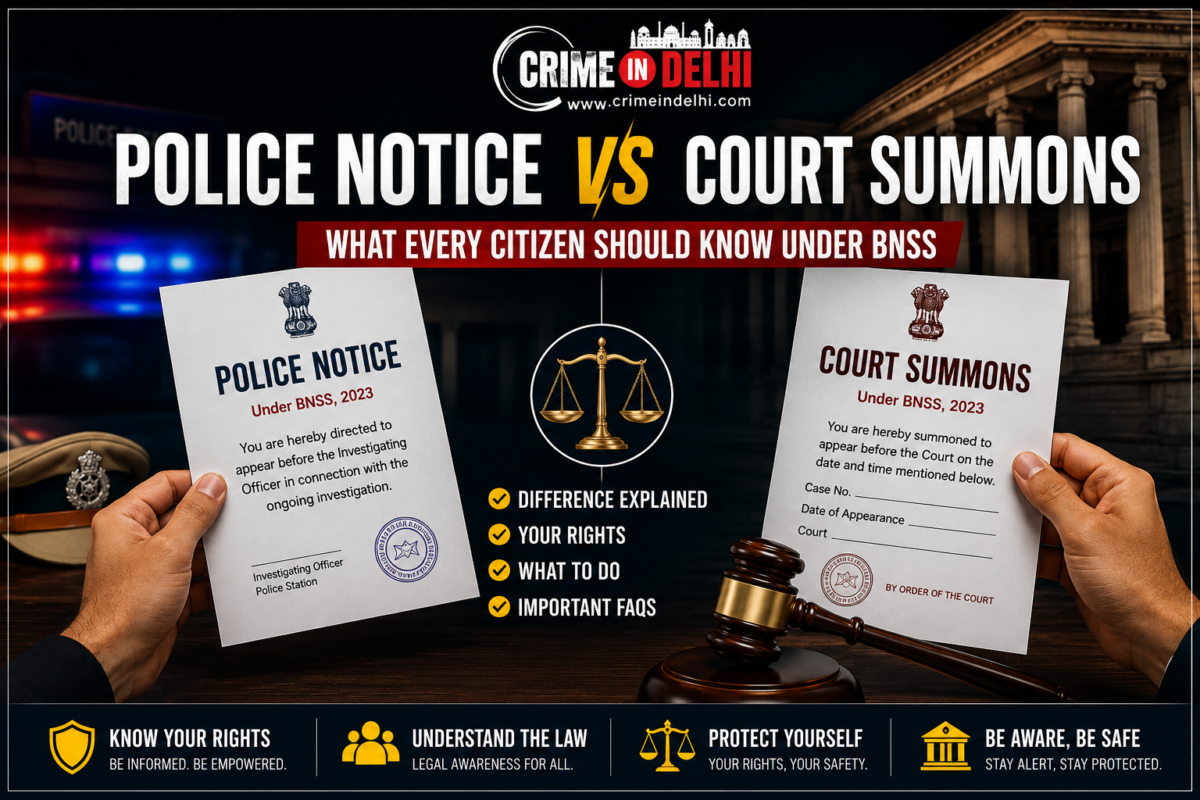
“Understanding the law is the first step towards protecting your rights. A police notice and a court summons may appear similar, but they serve different legal purposes and carry different legal consequences.”
Imagine receiving a phone call from the police asking you to visit the police station, or finding an official legal document at your doorstep directing you to appear before a court. For many people, the immediate reaction is fear and confusion.
Questions such as “Am I being arrested?”, “Have I committed an offence?”, or “Can I ignore this?” immediately come to mind.
The truth is that not every communication from the police or the court carries the same legal meaning. A Police Notice and a Court Summons are two different legal instruments under Indian criminal procedure. While both may require your appearance, they are issued by different authorities, at different stages of a criminal case, and for different legal purposes.
Unfortunately, many citizens do not know the difference. As a result, some panic unnecessarily, while others make the mistake of ignoring official communications, which can create avoidable legal complications.
The Bharatiya Nagarik Suraksha Sanhita, 2023 (BNSS), which replaced the Code of Criminal Procedure (CrPC), has introduced several procedural reforms. Understanding how a police notice differs from a court summons is now more important than ever.
In this article, we explain these concepts in simple language so that every citizen knows what these documents mean, when they are issued, and how they should respond.
Why This Topic Matters
Every day, police officers across India contact individuals during criminal investigations. Sometimes they issue a formal notice asking a person to appear before the Investigating Officer. In other situations, a court may issue a summons directing a person to appear before a Judicial Magistrate.
Although both documents ask someone to appear, they are not the same.
Many people wrongly believe that receiving a police notice automatically means they will be arrested. Others assume that a summons from a court can safely be ignored because they have “done nothing wrong.”
Both assumptions are incorrect.
Knowing the difference between these legal processes is important because your rights, obligations and the legal consequences vary depending upon the document you receive.
Whether you are a witness, a complainant, or a person against whom allegations are being investigated, understanding the legal significance of a notice or summons can help you make informed decisions and avoid unnecessary mistakes.
Can the Police Simply Call You to the Police Station?
One of the most common questions people ask is: “Can the police simply call me and ask me to come to the police station?”
The answer depends upon the circumstances.
During an investigation, the police may contact individuals for various reasons. They may wish to record a statement, seek clarification, verify certain facts, or request cooperation in an ongoing investigation.
However, there is an important distinction between:
- A casual phone call,
- A written notice issued during investigation, and
- A summons issued by a court.
A phone call, by itself, is generally not the same as a statutory notice under the BNSS. While many investigations begin with telephonic communication for convenience, important legal directions requiring a person’s appearance are ordinarily expected to follow the procedure prescribed by law.
Therefore, whenever the police ask you to appear before them, it is advisable to politely ask:
- Under what case or investigation are you being called?
- Which police station is conducting the investigation?
- Whether a written notice has been issued.
- Whether your presence is required as a witness or for some other purpose.
Seeking this information does not amount to non-cooperation. It simply helps you understand your legal position before appearing.
What Is a Police Notice Under BNSS?
A Police Notice is a written communication issued by the Investigating Officer during the course of a criminal investigation.
Its primary purpose is to request the appearance of a person whose presence is considered necessary for the investigation. The notice allows the police to question the person, verify facts, collect information, or seek cooperation without immediately resorting to arrest where the law permits such a course.
Under the BNSS, this mechanism reflects an important principle of criminal procedure:
Arrest should not become the first response in every investigation. Where the law permits, the investigating agency should first seek cooperation through lawful procedures before considering more coercive measures.
Receiving such a notice does not automatically mean that the recipient is guilty of any offence. A person may receive a notice because they are:
- a witness,
- a person acquainted with the facts of the case,
- or an individual whose role requires clarification during the investigation.
For this reason, a police notice should never be ignored, but it also should not be viewed as proof of criminal liability.
CrimeInDelhi Practical Tip
If you receive a written police notice:
- Read it carefully.
- Verify the FIR number, police station and investigating officer.
- Keep a copy of the notice.
- Cooperate with the investigation.
- If you are unsure about your legal rights or believe the matter is serious, consult an advocate before appearing.
What Is a Court Summons?
Unlike a police notice, a Court Summons is a formal legal document issued by a court requiring a person to appear before it on a specified date and time. It is generally issued after a case reaches the judicial stage, where the court considers the presence of a person necessary for the proceedings.
A summons may be issued to an accused person, a witness, a complainant, or any other individual whose appearance is required for the fair conduct of the case.
Receiving a court summons does not automatically mean that you have been found guilty of any offence. In many cases, witnesses, experts, government officials, and even complainants receive summons to appear before the court to assist in the administration of justice.
Under the Bharatiya Nagarik Suraksha Sanhita, 2023 (BNSS), summons are issued in a prescribed manner and may also be served through electronic means where permitted by law. The summons usually contains important details such as:
- The name of the court issuing the summons.
- The case number.
- The date and time of appearance.
- The purpose for which your appearance is required.
- The consequences of failing to appear without sufficient cause.
Unlike a police notice, which is issued during an investigation, a court summons forms part of judicial proceedings. Therefore, ignoring a summons can have more serious legal consequences, and the court may take further action as permitted under the law.
Also Read: What to Do If Delhi Police Refuse to Register an FIR – Legal Remedies Explained
Police Notice vs Court Summons: What Is the Difference?
Although both a police notice and a court summons require a person to appear before a lawful authority, they serve different legal purposes and are issued at different stages of a criminal case.
A Police Notice is issued by the Investigating Officer during the course of a criminal investigation. Its purpose is to seek the cooperation of a person whose presence is considered necessary for the investigation. Receiving such a notice does not automatically mean that the person is an accused or that an arrest is imminent. In many cases, notices are issued to witnesses or individuals who may possess information relevant to the investigation.
A Court Summons, on the other hand, is issued by a court after judicial proceedings have commenced. It is a formal direction requiring a person to appear before the court on a specified date and time. A summons may be issued to an accused person, a complainant, a witness, or any other individual whose presence is required for the proper conduct of the case.
Another important distinction is that a police notice forms part of the investigation process, whereas a court summons forms part of the judicial process. While both documents should be taken seriously, a court summons carries the authority of the court, and failure to comply without sufficient cause may result in further legal action as permitted by law.
Therefore, instead of assuming that every official communication has the same legal effect, citizens should first identify who has issued the document, why it has been issued, and what the law requires them to do. Understanding this distinction helps individuals respond appropriately and avoid unnecessary fear or legal complications.
Can the Police Arrest You After Issuing a Notice?
This is perhaps the most common question people ask. The simple answer is: Not necessarily.
Many people believe that once the police issue a notice, arrest is certain. That is not the correct legal position.
A notice issued during investigation is generally intended to secure a person’s cooperation without immediately resorting to arrest where the law permits such a course. If the person complies with the notice, cooperates with the investigation, and there are no legal grounds requiring custodial arrest, the investigating agency may continue the investigation without taking the person into custody.
However, this does not mean that a person who has received a notice can never be arrested.
If, during the investigation, legally recognised grounds for arrest arise under the applicable provisions of the BNSS, the police may exercise their statutory powers in accordance with law. Every arrest, however, must satisfy the legal requirements and constitutional safeguards applicable to criminal investigations.
Therefore, receiving a notice should neither create unnecessary panic nor a false sense of security. Every case depends upon its own facts and circumstances.
Can the Police Send a Notice Through WhatsApp, Email or Other Electronic Means?
With increasing use of technology, many people now receive communications from investigating agencies through electronic platforms.
Under the BNSS, electronic modes of communication have been recognised in several procedural aspects. Similarly, courts have also acknowledged electronic service of summons in appropriate circumstances where permitted by law.
However, citizens should exercise caution.
Not every WhatsApp message claiming to be from the police should be treated as genuine.
If you receive an electronic communication claiming to be a police notice, you should verify:
- Whether it mentions the police station.
- Whether the name and designation of the Investigating Officer are mentioned.
- Whether it contains an FIR number or DD entry, where applicable.
- Whether the contact details correspond to the concerned police station.
If you have any doubt regarding its authenticity, you may contact the concerned police station directly or seek legal advice before responding.
Verifying the communication is a sign of prudence—not non-cooperation.
Also Read: क्या पुलिस आपका मोबाइल फ़ोन चेक कर सकती है? जानिए अपने कानूनी अधिकार
What Should You Do If You Receive a Police Notice or Court Summons?
Receiving an official legal document can be stressful. However, your response should always be guided by law rather than panic.
As a general rule:
- Read the document carefully from beginning to end.
- Verify the issuing authority.
- Check the date, time and place of appearance.
- Preserve a copy of the notice or summons.
- Carry valid identification when appearing before the authority.
- Cooperate respectfully with lawful proceedings.
- If the matter involves serious criminal allegations or you are uncertain about your legal position, consult a qualified advocate before taking further steps.
Ignoring official legal communications without sufficient reason can often create avoidable legal complications. On the other hand, informed and timely compliance usually helps protect your legal rights.
CrimeInDelhi Practical Tip
Many people panic the moment they receive a call or notice from the police. Others make the opposite mistake and ignore it completely. Neither approach is advisable.
Understand who has issued the document, why it has been issued, and what the law requires you to do. If you are unsure, seek professional legal advice rather than relying solely on social media or unofficial sources.
What Are Your Rights If You Receive a Police Notice or Court Summons?
Receiving a police notice or a court summons does not mean that you lose your legal rights. Indian law ensures that every individual is treated fairly and in accordance with the principles of natural justice.
Some of the important rights every citizen should remember are:
1. You Have the Right to Know Why You Are Being Called
If you receive a police notice or court summons, you are entitled to know the purpose of your appearance. Read the document carefully and understand whether you are being called as a witness, complainant, or in connection with an investigation.
2. You Have the Right to Consult an Advocate
If you are uncertain about your legal position, you may seek legal advice before appearing. Consulting an advocate helps you understand your rights and obligations under the law.
3. Cooperate, But Know Your Rights
The law expects citizens to cooperate with lawful investigations and court proceedings. At the same time, cooperation does not mean giving up your legal protections.
4. Never Ignore Official Communication
One of the biggest mistakes people make is ignoring notices or summons because they believe the matter will disappear on its own.
In reality, ignoring a lawful notice or summons may create additional legal complications.
5. Preserve Every Document
Always keep copies of notices, summons, emails, WhatsApp messages, and any other communication received from the investigating agency or the court. These documents may become important later.
Common Mistakes People Make
Legal awareness is often affected by misinformation circulating on social media. Here are some common mistakes that should be avoided.
– Panic Immediately
Receiving a notice does not automatically mean you will be arrested.
– Ignore the Notice
Ignoring official communication without sufficient reason may lead to unnecessary legal complications.
– Believe Every Social Media Video
Many online videos provide incomplete or incorrect legal information. Always verify legal advice from reliable sources or consult a qualified advocate.
– Provide False Information
Giving false information during an investigation may create additional legal issues. If you do not know an answer, it is always better to state the facts truthfully.
– Destroy Documents or Digital Evidence
Never attempt to delete relevant documents, messages or electronic records after receiving legal communication. Such actions may adversely affect your legal position.
Myth vs Fact
Myth: Every police notice means arrest.
Fact: No. A police notice is often issued to seek cooperation during an investigation and does not automatically mean that the recipient will be arrested.
Myth: A court summons means the person has already been convicted.
Fact: Incorrect. A summons only requires a person’s appearance before the court. It does not determine guilt or innocence.
Myth: Police can arrest anyone immediately after making a phone call.
Fact: A phone call itself is not an arrest order. Every arrest must comply with the applicable legal provisions and constitutional safeguards.
Myth: Ignoring a notice is better than appearing.
Fact: Ignoring lawful communication may create unnecessary legal complications. It is always advisable to understand the document and respond appropriately.
CrimeInDelhi Legal View
Understanding the difference between a police notice and a court summons is not merely a legal technicality—it is an important aspect of protecting your rights as a citizen.
Unfortunately, fear and misinformation often cause people to react without understanding the legal process. Some individuals panic unnecessarily, while others ignore official communications altogether. Neither approach is advisable.
A responsible citizen should remain calm, verify the authenticity of the communication, understand its purpose, cooperate with lawful authorities, and seek professional legal advice whenever required.
The objective of criminal procedure is not merely to investigate offences but also to ensure that every person’s legal rights are protected throughout the process.
Legal awareness empowers citizens to make informed decisions rather than emotional ones.
Key Takeaways
- A Police Notice and a Court Summons are different legal documents.
- A police notice is generally issued during an investigation.
- A court summons is issued by a court during judicial proceedings.
- Receiving a police notice does not automatically mean arrest.
- Never ignore official legal communication.
- Verify every notice before responding.
- If you are uncertain, consult a qualified advocate.
Frequently Asked Questions (FAQs)
Q1. Can police call me over the phone without issuing a written notice?
Yes. Police may contact individuals telephonically during an investigation. However, important legal directions requiring appearance are generally expected to follow the procedure prescribed under law.
Q2. Can I refuse to receive a police notice?
Refusing to receive a lawful notice is generally not advisable. It is better to understand its contents and seek legal advice if required.
Q3. Does receiving a police notice mean I am an accused?
No. A person may receive a notice as a witness, a complainant, or someone whose presence is required during the investigation.
Q4. Can police arrest me after issuing a notice?
Depending on the facts of the case and the applicable legal provisions, arrest may or may not be necessary. Every case is different.
Q5. Can a court issue summons through electronic means?
The BNSS recognises electronic service of summons in appropriate cases, subject to the applicable legal framework.
Q6. Should I consult an advocate after receiving a notice?
If you are unsure about your legal position or the matter involves serious allegations, consulting an advocate is advisable.
Q7. Can I ignore a court summons?
Ignoring a court summons without sufficient cause may result in further legal consequences. It is advisable to appear or seek appropriate legal relief through an advocate.
Q8. What documents should I carry while appearing before the police or the court?
Carry the original notice or summons, a valid identity proof, and any documents specifically mentioned in the communication.
That means, receiving a police notice or a court summons is not a reason to panic. Both are legal procedures designed to ensure that investigations and court proceedings are conducted fairly and efficiently.
The key is to understand who has issued the document, why it has been issued, and what the law expects from you. Responding calmly, verifying the communication, cooperating with lawful authorities, and seeking legal advice whenever necessary will help protect your rights.
Legal awareness is one of the strongest safeguards available to every citizen. The more we understand the law, the better equipped we are to deal with legal situations responsibly and confidently.
By Advocate Ravi – Founder & Editor, CrimeInDelhi.com
Disclaimer: This article is intended for informational and legal awareness purposes only. It does not constitute legal advice. Readers should consult a qualified advocate for advice relating to their specific legal issues.
Also Read: National Commission for Men Bill: Why Is India Debating a Separate Commission for Men?