
“Every child has the right to equal protection under the law. Child protection laws are meant to safeguard every minor, irrespective of religion or personal law.”
Why Is This Judgment in the News?
A recent judgment of the Allahabad High Court has triggered widespread discussion across the country. Many social media posts claim that the Court has ruled that personal law cannot override the POCSO Act and the Prohibition of Child Marriage Act, 2006.
Some people have welcomed the decision, while others have questioned its impact on personal laws. Unfortunately, much of the discussion on social media focuses only on headlines without explaining what the Court actually decided.
The judgment is not merely about one religion or one community. It raises a much larger legal question:
Also Read: Mother कमाती है तो क्या Father की Child Maintenance आधी हो जाएगी? Supreme Court का बड़ा फैसला
Editor’s Note: This article explains the legal principles discussed in the judgment in simple language. It is intended to promote legal awareness and should not be interpreted as expressing any opinion on religion or any ongoing criminal proceedings.
Can a personal law prevail over a child protection law enacted by Parliament?
To answer this question, it is important to understand the facts of the case, the laws involved, and the reasoning adopted by the Allahabad High Court.
Judgment at a Glance
Court: Allahabad High Court
Case Name / Parties Involved: R and Others v. State of U.P. and Others (alternatively cited as Rubi and Ors. v. State of UP).
Date of Judgment: 1 July 2026.
Bench: Division Bench comprising Justice J.J. Munir and Justice Achal Sachdev
Issue: Can Personal Law override the POCSO Act and the Prohibition of Child Marriage Act?
Decision: No.
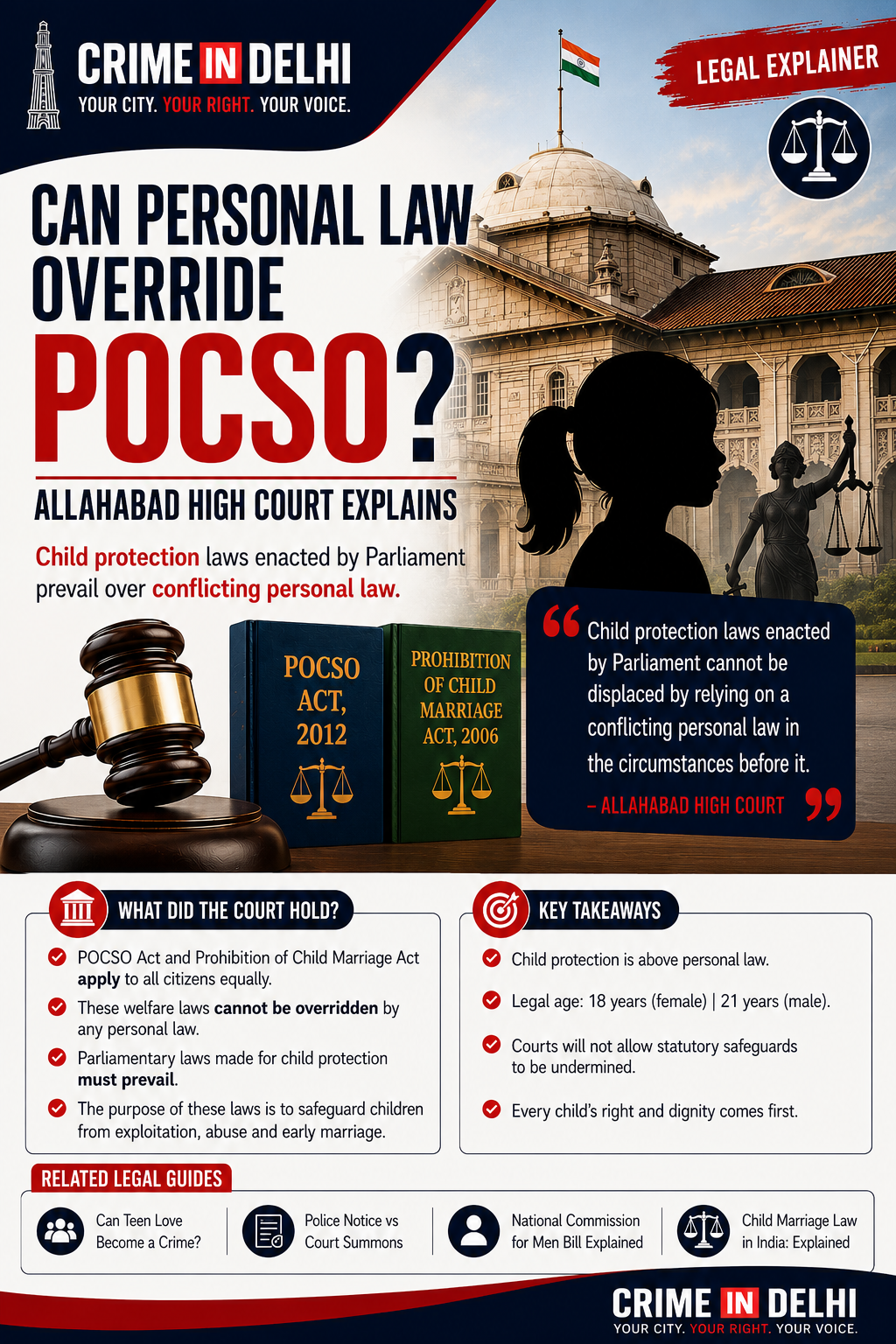
Key Observation: Child protection laws enacted by Parliament prevail where they apply.
Impact: The judgment reinforces that welfare legislation protecting children cannot be displaced by conflicting personal law in the circumstances considered by the Court.
What Was the Case About?
Police in Uttar Pradesh allegedly received information that a 16-year-old girl’s marriage was being arranged.
According to the prosecution, officials from the police and Child Line reached the location to prevent the child marriage and to take the minor into protective custody in accordance with the law. During this process, it was alleged that the officials were obstructed from performing their duties, leading to the registration of a criminal case against several persons.
The accused later approached the Allahabad High Court seeking quashing of the FIR.
One of their main arguments was that under Muslim Personal Law, a girl who has attained puberty is considered capable of entering into a valid marriage. Therefore, they argued that the criminal proceedings based on the child marriage laws should not continue.
This argument required the High Court to examine an important legal issue concerning the relationship between personal laws and statutory child protection laws enacted by Parliament.
What Was the Main Question Before the Court?
The Allahabad High Court was not deciding whether one religion is superior to another.
Nor was it deciding whether personal laws should be abolished.
The real legal question before the Court was much narrower:
If a personal law permits something, but a law passed by Parliament prohibits it, which law will apply?
More specifically, the bench had to consider whether the provisions of the Protection of Children from Sexual Offences (POCSO) Act, 2012 and the Prohibition of Child Marriage Act, 2006 (PCMA) could be ignored by relying on a rule of personal law.
This question was important because both the POCSO Act and the Child Marriage Act were enacted by Parliament with the objective of protecting children from exploitation, abuse and early marriage.
The answer given by the bench would therefore have implications not only for the parties involved in the case but also for future cases involving similar legal issues.
What Did the Allahabad High Court Hold?
After considering the arguments, the Allahabad High Court refused to quash the FIR.
The Bench observed that child protection laws enacted by Parliament apply equally to all citizens and cannot be defeated by relying on a conflicting rule of personal law.
In simple words, it further held that where the POCSO Act and the Prohibition of Child Marriage Act apply, they cannot be overridden by a personal law that permits marriage after puberty.
The Court emphasized that these statutes are welfare legislations enacted to protect children, and their object would be defeated if exceptions were created on the basis of personal laws.
It is important to note that the Court did not declare any religion or personal law invalid. Instead, it clarified that when there is a conflict in the context of child protection, the statutory safeguards created by Parliament must prevail.
Important Observation of the Court
The Court clarified that child-protection laws enacted by Parliament cannot be displaced by relying on a conflicting personal law in the circumstances before it. This formed the basis for refusing to interfere with the criminal proceedings.
Why Is This Judgment Important?
This judgment is significant because it goes beyond the facts of one criminal case.
It addresses an issue that has repeatedly arisen before Indian courts over the years:
Can personal laws override laws enacted by Parliament for the protection of children?
By answering this question, the Allahabad High Court has reaffirmed that child protection remains a matter of public interest and that welfare laws enacted by Parliament must be given full effect.
At the same time, the judgment does not change the personal laws applicable to different communities in every respect. It is confined to the legal issue before the Court and the application of child protection statutes in that context.
Understanding the Law: Why Did the Court Reach This Conclusion?
To understand the Allahabad High Court’s decision, it is first necessary to understand the three laws that formed the centre of this dispute.
These are:
- The Protection of Children from Sexual Offences (POCSO) Act, 2012 – Child means every person below 18 years and Protects children from sexual offences.
- The Prohibition of Child Marriage Act, 2006 (PCMA) – Female – 18 years, Male – 21 years, and also Provides legal remedies and punishment relating to child marriage.
- Muslim Personal Law, which was relied upon by the accused.
Let’s understand each of them in simple language.
What Is the POCSO Act?
The POCSO Act protects every child below 18 years of age from sexual offences.
In simple words, if a person is below 18 years, the law gives them special legal protection, regardless of their religion or background.
Example: If a 16-year-old is involved in a case, the protections under the POCSO Act apply because the law treats that person as a child.
One of the most important features of the Act is that a child’s consent is not recognised as a legal defence for sexual offences covered under the Act. The law treats minors as legally incapable of giving valid consent for such acts.
The objective of the POCSO Act is to protect children from sexual exploitation, abuse and harassment through a special legal framework that ensures speedy investigation and trial.
What Is the Prohibition of Child Marriage Act, 2006?
Parliament enacted the Prohibition of Child Marriage Act (PCMA), 2006 to discourage child marriages. Under this law:
- A male must be at least 21 years old to marry.
- A female must be at least 18 years old to marry.
The Act also provides legal remedies to children who become victims of child marriage and prescribes punishment for persons who perform, promote or facilitate such marriages.
The purpose of the law is not merely to punish offenders but also to safeguard the health, education, dignity and future of children.
Parliament enacted this legislation after recognising that child marriage often deprives children of education, exposes them to exploitation and affects their physical and mental well-being.
What Was the Argument Based on Muslim Personal Law?
The accused argued that under Muslim Personal Law, a girl who has attained puberty is considered capable of entering into a valid marriage.
Based on this argument, they contended that the criminal proceedings arising out of the alleged child marriage should not continue.
It is important to understand that the Allahabad High Court was not examining the validity of Muslim Personal Law as a whole.
Instead, the Court had to decide a much narrower legal question:
Can a personal law be relied upon to avoid the application of child protection laws enacted by Parliament?
This distinction is important because the judgment deals with the interaction between different legal frameworks, not with the validity of any religion.
Why Did the Allahabad High Court Reject This Argument?
After examining the legal provisions, the Allahabad High Court held that the POCSO Act and the Prohibition of Child Marriage Act are special welfare legislations enacted by Parliament to protect children.
The Court observed that allowing a conflicting rule of personal law to override these statutes would defeat the very purpose for which Parliament enacted them.
In simple words, the Court said that Parliament’s child protection laws apply equally to every child.
Therefore, where a conflict arises between child protection legislation and a personal law, the statutory provisions enacted for the welfare of children must prevail.
In simple terms, the Court held that no child can be denied the protection of the POCSO Act or the Child Marriage Act merely because a different rule exists under a personal law.
What Does the Constitution Say?
Although the judgment mainly dealt with statutory law, it also reflects important constitutional principles.
Article 14 – Equality Before Law
Article 14 guarantees that every person is entitled to equality before the law and equal protection of the laws.
This means that laws enacted for the protection of children should apply equally to all children unless the Constitution itself provides otherwise.
Article 15(3) – Protection of Women and Children
The Constitution specifically allows the State to make special laws for women and children.
The POCSO Act and the Prohibition of Child Marriage Act are examples of welfare legislation enacted to protect vulnerable sections of society.
Article 21 – Right to Life and Dignity
The Supreme Court has repeatedly held that Article 21 includes the right to live with dignity.
Protecting children from exploitation, abuse and forced or early marriage forms part of the State’s constitutional responsibility to safeguard their dignity and development.
Article 25 – Freedom of Religion
Article 25 guarantees every person the freedom to profess, practise and propagate religion. However, this freedom is not absolute.
The Constitution itself makes this right subject to public order, morality, health and other provisions of Part III.
Where Parliament enacts welfare legislation for the protection of children, courts may examine how those statutory protections operate alongside personal law in the facts of a particular case.
That is precisely what the Allahabad High Court considered while deciding this matter.
Did the Court Declare Personal Law Invalid?
No. This is one of the biggest misconceptions circulating on social media.
The Allahabad High Court did not declare Muslim Personal Law unconstitutional or invalid.
Instead, the Court held that where the POCSO Act and the Prohibition of Child Marriage Act apply, those statutory protections cannot be displaced by relying on a conflicting personal law in the circumstances before it.
This distinction is extremely important. The judgment is about the application of child protection laws, not about abolishing or invalidating personal laws.
What Have the Supreme Court and Other Courts Said Earlier?
The Allahabad High Court’s decision is not the first time Indian courts have emphasised the importance of protecting children.
In Independent Thought v. Union of India (2017), the Supreme Court held that a husband cannot claim immunity from prosecution for sexual intercourse with his wife if she is below 18 years of age. The Court observed that the dignity, bodily integrity and rights of a child cannot be compromised merely because the child is married.
Over the years, courts have consistently recognised that child welfare is a matter of public interest and that laws enacted to protect children must be interpreted in a manner that advances their purpose.
The Allahabad High Court’s judgment follows the same principle by giving priority to child protection laws enacted by Parliament.
Common Misconceptions
Whenever an important judgment becomes a topic of public discussion, misinformation spreads quickly. Here are some common misconceptions surrounding this decision.
Myth: The Court has abolished Muslim Personal Law.
Fact: No. The Court did not declare Muslim Personal Law invalid. It only held that in the facts before it, statutory child protection laws could not be overridden by relying on a conflicting personal law.
Myth: The judgment applies only to one religion.
Fact: The Court emphasised that the POCSO Act and the Prohibition of Child Marriage Act are welfare legislations enacted by Parliament and apply equally to all children.
Myth: Child marriage automatically becomes valid because of personal law.
Fact: The legal consequences of a child marriage depend upon the applicable statutory framework. Courts examine each case according to the relevant laws enacted by Parliament.
Myth: Every case involving a minor and marriage will have the same outcome.
Fact: No. Every case depends on its own facts, evidence and the applicable legal provisions. This judgment explains an important legal principle but does not decide every future case.
CrimeInDelhi Legal View
The Allahabad High Court’s judgment should not be viewed through the lens of politics or religion. At its core, the decision is about the protection of children.
India’s Constitution permits different personal laws to govern various aspects of family life. At the same time, Parliament has enacted welfare laws to protect vulnerable sections of society, particularly women and children.
This judgment explains that when a conflict arises between a child protection statute and a contrary personal law in the context before the Court, the statutory protection enacted for the welfare of children must prevail.
The discussion should therefore remain focused on legal principles rather than social media narratives.
Understanding judgments in their proper legal context helps citizens appreciate not only what the Court decided but also why it reached that conclusion.
Key Takeaways
- The Allahabad High Court refused to quash the FIR in the case before it.
- The Court held that the POCSO Act and the Prohibition of Child Marriage Act are welfare legislations enacted to protect children.
- These statutory protections cannot be overridden by relying on a conflicting personal law in the circumstances considered by the Court.
- The judgment does not declare Muslim Personal Law unconstitutional or invalid.
- Child protection laws enacted by Parliament apply uniformly to protect minors.
- Every case is decided on its own facts and applicable legal provisions.
Frequently Asked Questions (FAQs)
Q1. Did the Allahabad High Court ban Muslim Personal Law?
No. The Court did not ban or declare Muslim Personal Law invalid. It only decided the legal issue before it regarding the application of child protection laws.
Q2. Does this judgment apply only to Muslims?
No. The Court discussed laws enacted by Parliament that apply to the protection of children irrespective of religion.
Q3. Why did the Court give priority to the POCSO Act?
Because the POCSO Act is a special welfare legislation enacted to protect children from sexual offences.
Q4. What is the legal age of marriage in India?
Under the Prohibition of Child Marriage Act, the minimum age is 18 years for women and 21 years for men.
Q5. Does this judgment change the law?
No. The judgment interprets and applies the existing law. It does not create a new statute.
Q6. Can an FIR be quashed simply by relying on personal law?
That depends on the facts and legal issues involved. In this case, the Allahabad High Court declined to quash the FIR.
Q7. Why is this judgment important?
Because it clarifies the relationship between child protection laws enacted by Parliament and conflicting personal law arguments in the context of the case before the Court.
The Allahabad High Court’s judgment is an important reminder that child protection remains one of the strongest priorities of Indian law.
While personal laws continue to govern many aspects of family life, Parliament has enacted special statutes such as the POCSO Act and the Prohibition of Child Marriage Act to safeguard children from exploitation and early marriage.
The Court’s decision does not diminish the importance of personal laws. Instead, it clarifies that where Parliament has enacted welfare legislation specifically to protect children, those statutory safeguards cannot be displaced in the circumstances considered by the Court.
The judgment is not about giving preference to one religion over another. It is about ensuring that every child in India receives the protection guaranteed by laws enacted for their welfare.
For citizens, the biggest takeaway is simple: understanding the law is far more valuable than relying on incomplete social media posts or misleading headlines.
By Advocate Ravi – Founder & Editor | CrimeInDelhi.com
Advocate Ravi writes on criminal law, constitutional law, court judgments and legal awareness. Through CrimeInDelhi.com, the aim is to make Indian law easier to understand for every citizen.
Related Legal Guides
➡ Police Notice vs Court Summons Explained
➡ National Commission for Men Bill Explained
➡ Can Teen Love Become a Crime?
Disclaimer: This article is intended for legal awareness and informational purposes only. It is based on the Allahabad High Court judgment and the applicable statutory framework as understood on the date of publication. It should not be treated as legal advice. Readers should consult a qualified advocate for advice relating to their specific legal issues.