
Published by CrimeInDelhi
Key Takeaways
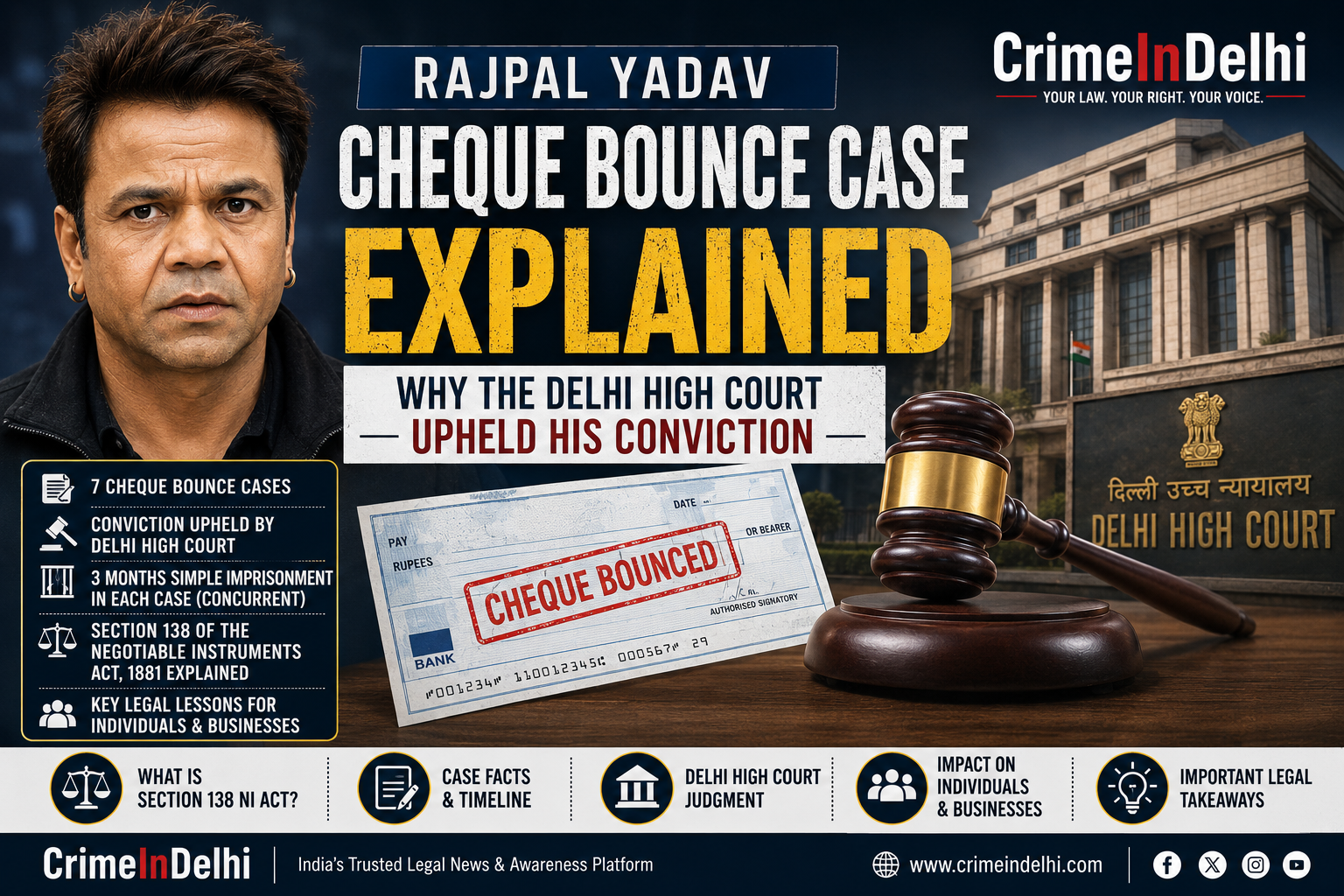
- The Delhi High Court has upheld actor Rajpal Yadav’s conviction in seven cheque dishonour cases under Section 138 of the Negotiable Instruments Act, 1881.
- While the Court reduced the sentence from six months to three months’ simple imprisonment, it refused to interfere with the findings of guilt recorded by the lower courts.
- The judgment highlights that issuing a cheque is a serious legal commitment and dishonouring it can lead to criminal prosecution if the statutory conditions are satisfied.
- The case is not just about a Bollywood actor—it serves as an important reminder for individuals, professionals, businesses, startups, partnerships, and companies that cheque transactions carry legal consequences.
Editorial Note
This article explains the legal issues arising from the Rajpal Yadav cheque bounce case using publicly available court reports and reliable news sources. It is intended purely for educational and informational purposes and should not be treated as legal advice. The objective is to explain the law in simple language and help readers understand how India’s cheque dishonour provisions work in practice.
Can a Bounced Cheque Really Lead to Imprisonment?
Most people believe that a bounced cheque is merely a financial dispute that can be settled later. Others assume that if they eventually repay the money, the legal case will automatically disappear. These assumptions are common—but they are not always correct.
The recent Delhi High Court judgment involving Bollywood actor Rajpal Yadav has once again brought India’s cheque bounce law into the national spotlight. The case demonstrates that a cheque is not merely a payment instrument. In law, it represents a promise to honour a financial obligation. When that promise is broken and the legal requirements under the Negotiable Instruments Act are fulfilled, the consequences can extend beyond civil liability and result in criminal prosecution.
Although the case involves a well-known public figure, the legal principles are the same for everyone. Whether you are an employee issuing a cheque to repay a personal loan, a landlord accepting rent through cheque, a business owner making payments to suppliers, or a company issuing post-dated cheques to creditors, the law applies equally.
The Rajpal Yadav judgment is therefore significant not because of the celebrity involved, but because it reminds every cheque holder that financial commitments backed by a cheque are enforceable under law.
Who is Rajpal Yadav?
Rajpal Yadav is one of India’s most recognised comedy actors. Over the past two decades, he has appeared in numerous Hindi films and earned a reputation for portraying memorable comic characters. His performances in movies such as Hungama, Bhool Bhulaiyaa, Mujhse Shaadi Karogi, Chup Chup Ke, Garam Masala, and many others made him a familiar face among Indian audiences.
However, in July 2026, his name appeared in headlines for reasons unrelated to cinema.
Instead of discussing a new film release, newspapers across the country reported that the Delhi High Court had upheld his conviction in multiple cheque dishonour cases, confirming that he would undergo three months’ simple imprisonment in each of the seven complaint cases, with all sentences running concurrently.
The decision attracted widespread public attention because it involved a celebrity. Yet, the judgment itself raises legal questions that affect thousands of ordinary cheque transactions every day across India.
Why Did This Case Become National News?
Cheque bounce cases are among the most frequently litigated financial disputes before criminal courts in India. Every year, thousands of complaints are filed under Section 138 of the Negotiable Instruments Act, 1881, by individuals, banks, companies, traders, landlords, and professionals seeking recovery of money through the legal process.
Ordinarily, many of these cases receive little public attention.
The Rajpal Yadav matter became national news because:
- It involved a well-known Bollywood actor.
- The dispute had continued for several years.
- The Delhi High Court examined the legality of the conviction after the trial court and appellate court had already found the accused guilty.
- The Court declined to grant probation and confirmed the conviction while modifying the sentence.
Beyond the celebrity angle, the judgment also reinforces an important legal message: courts expect parties to honour financial commitments and comply with undertakings given during judicial proceedings.
Understanding the Background of the Dispute
The origins of the dispute date back more than a decade.
According to court reports, the matter relates to financial transactions connected with the production of the Hindi film “Ata Pata Laapata”, which was released in 2012. The film was reportedly financed with funds borrowed from M/s Murli Projects Private Limited.
As part of the financial arrangement, several cheques were issued towards repayment of the outstanding liability. When those cheques were presented to the bank for encashment, they were dishonoured.
Under Indian law, a cheque being returned unpaid does not automatically result in criminal liability. However, when the statutory requirements prescribed under Section 138 of the Negotiable Instruments Act are fulfilled—such as issuance of a valid legal demand notice and failure to make payment within the prescribed period—the payee may initiate criminal proceedings before the competent Magistrate.
Following the dishonour of the cheques, the lender initiated multiple complaints under Section 138 of the Negotiable Instruments Act. Over the years, those complaints travelled through different stages of the judicial system before finally reaching the Delhi High Court.
A Timeline of the Rajpal Yadav Cheque Bounce Case
The litigation stretched across several years. While the finer procedural details are spread across multiple proceedings, the broad timeline is as follows:
2010–2012: Financial Arrangement
Funds were reportedly advanced in connection with the production of the film Ata Pata Laapata. As part of the repayment arrangement, cheques were issued in favour of the lender.
Dishonour of Cheques
When the lender presented the cheques for payment, they were returned unpaid. Following compliance with the statutory legal process, criminal complaints under Section 138 of the Negotiable Instruments Act were filed before the competent court.
Trial Court Proceedings
After considering the evidence, the trial court convicted the accused in the cheque dishonour complaints and imposed sentence in accordance with law.
Appeal Before the Sessions Court
The conviction was challenged before the appellate court. However, the appellate court substantially affirmed the findings of the trial court.
Revision Before the Delhi High Court
The matter ultimately reached the Delhi High Court through revision petitions challenging the concurrent findings of the lower courts.
Delhi High Court Judgment – July 10, 2026
Justice Swarana Kanta Sharma dismissed the revision petitions, upheld the conviction, modified the sentence to three months’ simple imprisonment in each of the seven complaint cases (to run concurrently), and refused to grant probation. The Court also directed payment of the fine imposed, subject to adjustment of amounts already deposited during the proceedings.
What Exactly Did the Delhi High Court Decide?
One important point that many news reports do not clearly explain is what the High Court was actually deciding. The High Court was not conducting a fresh trial.
It was examining whether the judgments passed by the trial court and affirmed by the appellate court suffered from any legal error serious enough to justify interference.
After reviewing the record, the Court concluded that there was no infirmity in the concurrent findings of guilt. As a result, it upheld the conviction recorded under Section 138 of the Negotiable Instruments Act.
At the same time, the Court modified the sentence by reducing the period of imprisonment from six months to three months’ simple imprisonment in each of the seven complaint cases, directing that all sentences would run concurrently. The Court also declined the request to extend the benefit of probation, observing that repeated opportunities and undertakings regarding repayment had not been honoured during the proceedings.
Why Did the Delhi High Court Uphold the Conviction?
Whenever a High Court hears a revision petition in a cheque dishonour case, it does not conduct the trial again or re-examine every piece of evidence as if the case were starting afresh. Instead, the Court primarily examines whether the trial court and the appellate court committed any serious legal error, ignored material evidence, or reached a conclusion that was unreasonable in law.
In Rajpal Yadav’s case, the Delhi High Court found no such error that justified interference with the concurrent findings of the lower courts. As a result, the conviction under Section 138 of the Negotiable Instruments Act remained intact.
While the Court reduced the sentence of imprisonment from six months to three months, it did not disturb the finding that the offence had been proved according to law. This distinction is important because a court may modify the sentence without setting aside the conviction. In other words, a person may still remain legally convicted even if the punishment is reduced.
The Court also declined to grant the benefit of probation. According to reports of the judgment, the Court noted that sufficient opportunities had already been given during the proceedings and that earlier undertakings regarding repayment had not been honoured. These circumstances weighed against extending the benefit of probation. Therefore, while the Court showed some leniency by reducing the jail term, it did not find any reason to erase the conviction itself.
This judgment demonstrates an important principle of criminal jurisprudence: revision jurisdiction is limited. Unless there is a clear legal error or miscarriage of justice, higher courts generally do not interfere with concurrent findings recorded by the trial and appellate courts.
What Is Section 138 of the Negotiable Instruments Act?
The Rajpal Yadav case revolves around Section 138 of the Negotiable Instruments Act, 1881, one of the most frequently invoked provisions in commercial and financial litigation in India.
Contrary to popular belief, every bounced cheque does not amount to a criminal offence. A cheque may be returned unpaid for several reasons, and criminal liability arises only when the conditions prescribed under Section 138 are satisfied.
The objective of Section 138 is to maintain trust and confidence in cheque transactions. Businesses, banks, employers, landlords, suppliers, and ordinary individuals rely on cheques as a recognised mode of payment. If cheques could be issued without any legal accountability, commercial transactions would become uncertain and unreliable.
For this reason, Parliament introduced criminal consequences for cheque dishonour in specific circumstances.
However, the law also provides safeguards for the person who issued the cheque. A complaint cannot be filed immediately after a cheque is returned unpaid. The payee must first follow the statutory procedure laid down under the Negotiable Instruments Act.
This balance between protecting creditors and safeguarding the rights of the drawer is one of the reasons why Section 138 has remained a significant part of India’s commercial law.
Does Every Bounced Cheque Result in Criminal Liability?
The simple answer is No. One of the biggest misconceptions among the public is that every dishonoured cheque automatically leads to a criminal case.
That is incorrect. A cheque may bounce for many reasons. Some situations may lead to prosecution under Section 138, while others may not.
For example:
- A cheque returned because of insufficient funds may attract Section 138 if all legal requirements are fulfilled.
- A cheque returned because the account has been closed may also attract liability.
- In some cases, stopping payment of a cheque may still result in proceedings, depending on the facts and evidence.
- However, where essential legal requirements are missing—for example, if the statutory demand notice is not served within the prescribed period or the complaint is filed beyond limitation without sufficient cause—the prosecution may fail.
Therefore, the dishonour of a cheque is only the beginning of the legal analysis. The court examines the entire sequence of events before determining criminal liability.
The Five Essential Ingredients of a Cheque Bounce Case
For a conviction under Section 138, the complainant must establish the statutory ingredients prescribed by law. If any essential ingredient is missing, the complaint may fail.
1. The Cheque Must Be Issued Towards a Legally Enforceable Debt or Liability
This is perhaps the most important requirement.
The cheque should have been issued in discharge of a legally enforceable debt or other liability.
For instance:
- Repayment of a personal loan.
- Payment to a supplier for goods.
- Payment of professional fees.
- Business transactions.
- Outstanding contractual obligations.
If a cheque was never issued towards a legally enforceable liability, the prosecution may face difficulty in proving the offence.
2. The Cheque Must Be Presented Within Its Validity Period
A cheque cannot be presented indefinitely.
The holder must present it to the bank within its period of validity.
Failure to do so may deprive the holder of the statutory remedy available under Section 138.
3. The Cheque Must Be Dishonoured
The bank must return the cheque unpaid.
Usually, the bank issues a Cheque Return Memo, specifying the reason for dishonour.
Common reasons include:
- Insufficient funds.
- Exceeds arrangement.
- Account closed.
- Payment stopped by drawer.
- Refer to drawer.
The return memo becomes an important document during the proceedings.
4. A Statutory Legal Notice Must Be Issued
Many people are unaware that the law requires the payee to issue a formal legal demand notice after receiving information regarding the dishonour of the cheque.
This notice provides the drawer with an opportunity to make payment before criminal proceedings are initiated.
Failure to comply with the statutory notice requirements can adversely affect the complaint.
5. Payment Must Not Be Made Within the Prescribed Period
If the drawer pays the cheque amount within the statutory period after receiving the legal notice, criminal liability under Section 138 generally does not arise.
Only when payment is not made within the prescribed time does the complainant acquire the right to approach the Magistrate by filing a complaint.
Thus, the law gives the drawer one final opportunity to honour the financial commitment before criminal proceedings begin.
Why Does the Law Give a Chance to Make Payment?
Many readers wonder:
“If my cheque bounced, why doesn’t the court immediately register a criminal case?”
The answer lies in the purpose of Section 138.
The object of the law is not to send people to jail at the first instance. Instead, the law encourages repayment.
That is why the Negotiable Instruments Act requires:
- dishonour of the cheque,
- issuance of a legal demand notice,
- waiting for the prescribed period,
- and only then filing of a criminal complaint if payment is still not made.
This procedure reflects the legislative intent of promoting financial discipline while also giving the drawer a fair opportunity to rectify the default.
What Can We Learn From the Rajpal Yadav Case?
Regardless of the identity of the parties, the case highlights several practical lessons.
Never Issue a Cheque Casually
A signed cheque is not merely a promise—it is a legal instrument that may form the basis of criminal proceedings if dishonoured and the statutory requirements are fulfilled.
Respond Promptly to a Legal Notice
Ignoring a demand notice is one of the most common mistakes made by parties. Seeking legal advice at an early stage often provides better options than waiting until criminal proceedings have already commenced.
Participate in Court Proceedings
Non-appearance before the court, failure to comply with directions, or ignoring undertakings may adversely affect the outcome of the case.
Honour Settlement Commitments
If a settlement is reached or an undertaking is given before the court, it should be honoured within the agreed time. Courts generally take compliance with their orders and recorded undertakings seriously.
Maintain Proper Financial Records
Businesses and individuals should preserve loan agreements, invoices, receipts, bank statements, and correspondence relating to cheque transactions. Proper documentation often becomes crucial evidence during litigation.
CrimeInDelhi Legal Insight
One of the biggest myths surrounding cheque bounce cases is that they are “just recovery matters.”
In reality, Section 138 proceedings combine elements of both financial recovery and criminal accountability. While many disputes are eventually settled through negotiation or mediation, ignoring the legal process can significantly increase the financial and legal consequences.
For businesses, issuing post-dated or security cheques without adequate financial planning can expose directors and authorised signatories to prolonged litigation. For individuals, casually issuing cheques to friends, relatives, landlords, or lenders without ensuring sufficient funds can lead to years of court proceedings.
The Rajpal Yadav judgment is a reminder that the legal system expects cheque transactions to be treated with seriousness, irrespective of the social or professional status of the person issuing the cheque.
Why This Judgment Matters Beyond One Celebrity Case
It is easy to dismiss the Rajpal Yadav judgment as a celebrity’s legal problem. However, doing so would mean overlooking the broader message behind the decision.
Every day, millions of cheque transactions take place across India. Individuals use cheques to repay personal loans, businesses pay suppliers through post-dated cheques, companies issue cheques to vendors, landlords accept rent through cheques, and financial institutions rely on them for loan repayments.
The legal principles applied in Rajpal Yadav’s case are exactly the same principles that apply to these ordinary transactions.
The judgment reminds us that a cheque is not just a piece of paper—it is a legal promise to make payment. When that promise is broken and the legal conditions under the Negotiable Instruments Act are fulfilled, the issuer may face criminal proceedings.
The case also demonstrates that litigation under Section 138 is often lengthy and expensive. A dispute that begins with a financial transaction can continue for years, requiring repeated appearances before different courts before reaching its conclusion.
What This Means for Individuals
If you issue cheques in your personal capacity, this judgment offers several practical lessons.
Whether you borrow money from a friend, purchase a vehicle, repay a family loan, pay school fees, or issue rent cheques to your landlord, every cheque carries legal consequences.
Before signing any cheque, ask yourself:
- Is there enough money in my account?
- Am I issuing this cheque towards a genuine liability?
- Will I be able to honour it on the presentation date?
- Have I maintained records of this transaction?
Many cheque bounce cases arise not because of fraud but because people issue cheques without planning their finances or understanding the legal consequences.
What This Means for Businesses
For business owners, cheque management is part of risk management.
Companies frequently issue post-dated cheques to:
- suppliers,
- contractors,
- transporters,
- consultants,
- service providers,
- landlords,
- lenders.
A dishonoured cheque can damage not only the business relationship but may also result in criminal complaints, financial penalties, and prolonged litigation.
Businesses should therefore establish internal controls before issuing cheques.
Some practical precautions include:
- Maintaining sufficient funds before the cheque date.
- Recording the purpose of every cheque.
- Avoiding unsigned or blank cheques.
- Reconciling bank accounts regularly.
- Responding immediately to legal notices.
Good financial discipline is often the best defence against unnecessary litigation.
What This Means for Companies and Directors
Many people mistakenly believe that only the company can be prosecuted.
That is not always correct. Under Section 141 of the Negotiable Instruments Act, certain officers of a company, including directors or persons responsible for the conduct of the company’s business, may also face legal proceedings depending on the facts of the case.
This is why companies should implement proper financial governance and ensure that authorised signatories understand the legal consequences of issuing cheques on behalf of the organisation.
A detailed discussion on company liability under Section 141 will be covered in the fourth article of this series.
Common Myths About Cheque Bounce Cases
Myth 1: Every bounced cheque is a criminal offence.
Reality: No. Criminal liability arises only when all statutory requirements under Section 138 are fulfilled.
Myth 2: Police immediately register an FIR.
Reality: Generally, cheque bounce cases are initiated through a private complaint before the Magistrate, not by registration of an FIR.
Myth 3: Going to court automatically means imprisonment.
Reality: No. Many cheque bounce cases are settled through negotiation, mediation, or payment during the proceedings. Conviction depends on the facts, evidence, and compliance with the law.
Myth 4: A legal notice can be ignored.
Reality: Ignoring a statutory demand notice is one of the biggest mistakes a person can make. Seeking legal advice promptly may help resolve the dispute at an early stage.
Myth 5: A blank signed cheque has no legal value.
Reality: A blank signed cheque may still have legal consequences depending on the circumstances and the evidence produced before the court.
Frequently Asked Questions (FAQs)
1. Can a bounced cheque lead to imprisonment?
Yes. If the statutory requirements under Section 138 of the Negotiable Instruments Act are satisfied and the accused is convicted by the court, imprisonment and/or fine may be imposed.
2. Is every cheque bounce case criminal?
No. Criminal liability arises only when the legal conditions prescribed by Section 138 are fulfilled.
3. Does a cheque bounce case automatically mean fraud?
No. A dishonoured cheque does not automatically establish fraudulent intention. Each case depends on its own facts and evidence.
4. Can the parties settle the dispute?
Yes. Many cheque bounce cases are settled through mutual agreement even after the complaint has been filed.
5. Can companies face cheque bounce cases?
Yes. Companies, partnership firms, LLPs, and, in appropriate cases, responsible officers may be prosecuted under the Negotiable Instruments Act.
6. Can a security cheque result in legal proceedings?
It depends on the facts of each case. Whether a security cheque attracts Section 138 has been the subject of several judicial decisions.
7. Should I ignore a legal notice?
No. Ignoring a legal notice may weaken your legal position. It is advisable to seek legal advice promptly.
8. Does the Rajpal Yadav judgment change the law?
No. The judgment applies existing legal principles to the facts of the case. It does not create a new offence or amend Section 138.
CrimeInDelhi Practical Takeaway
The Rajpal Yadav case is not important because it involves a celebrity.
It is important because it reminds every cheque holder that financial commitments made through cheques are enforceable under law.
If you issue a cheque:
- Ensure that sufficient funds are available.
- Keep proper documentation of the transaction.
- Respond promptly to legal notices.
- Honour settlements and court undertakings.
- Seek legal advice before the dispute escalates.
A timely response often prevents years of litigation.
The Delhi High Court’s decision in the Rajpal Yadav cheque bounce case is a reminder that financial discipline and legal compliance go hand in hand. While the case has drawn public attention because of the actor’s popularity, the legal principles involved apply equally to every individual, business, company, and professional who uses cheques in day-to-day transactions.
The judgment reinforces the objective of Section 138 of the Negotiable Instruments Act—to promote trust in commercial dealings by ensuring that cheques remain a reliable mode of payment. At the same time, it also illustrates that courts carefully examine the facts, evidence, and procedural requirements before recording a conviction.
For readers, the most important lesson is simple: issuing a cheque is a legal commitment, not merely a financial formality. Understanding your rights and obligations under the law can help avoid unnecessary disputes and protect your financial interests.
Disclaimer:
This article is published by CrimeInDelhi for informational and educational purposes only. It is based on publicly available court records, judicial proceedings, and reliable news reports available at the time of publication. The views expressed in this article are intended to explain the applicable law and should not be construed as legal advice or a legal opinion.
Every legal dispute depends on its own facts and circumstances. Readers are advised to consult a qualified advocate before making any legal decision or taking action based on the information contained in this article. CrimeInDelhi does not accept responsibility for any loss or liability arising from reliance on this publication.
© CrimeInDelhi Legal Explainer Series
This article is part of CrimeInDelhi’s ongoing effort to simplify Indian laws and court judgments for the public. Reproduction without permission is prohibited.