
Published by: CrimeInDelhi Desk
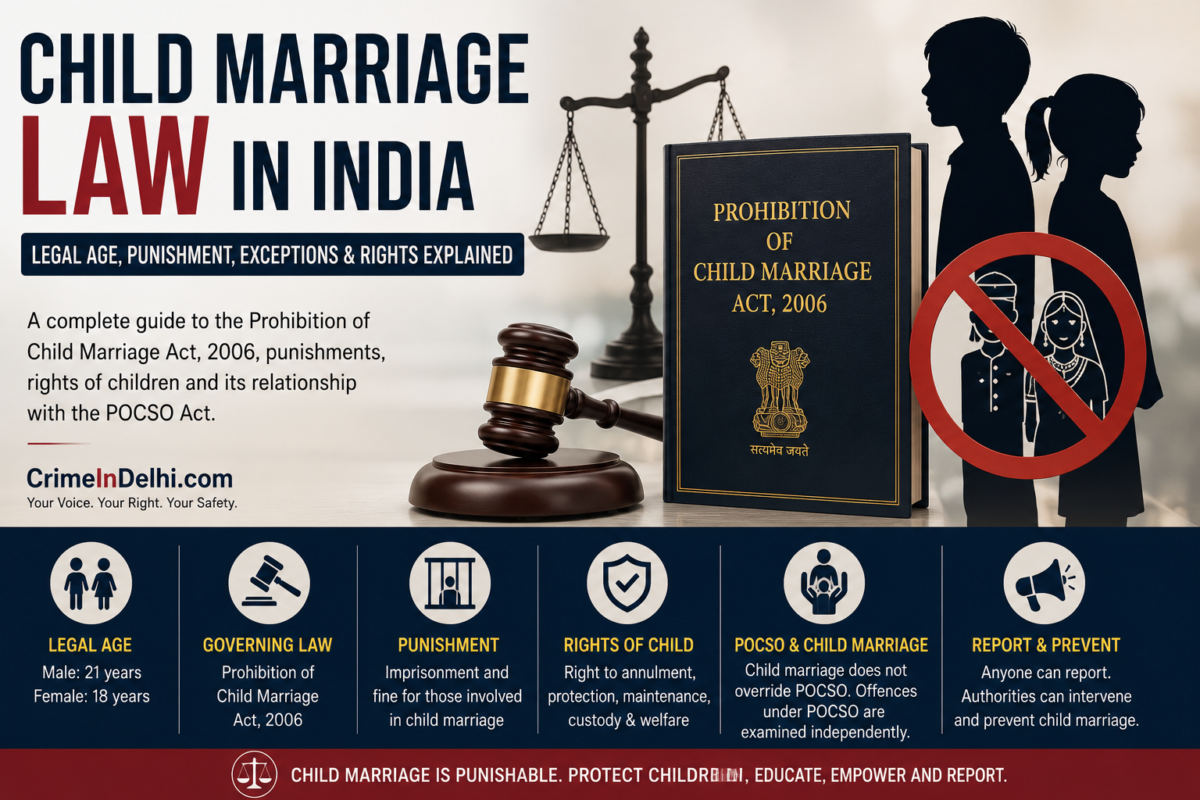
Child marriage remains a serious legal and social issue in India despite strict laws prohibiting the practice. Every year, authorities register cases where minors are married due to social customs, financial pressures, or other reasons. Besides affecting education and health, child marriage can also lead to criminal prosecution under Indian law.
This guide explains the legal age of marriage, the law governing child marriage, punishments, the rights of children involved, and how the law interacts with offences under the Protection of Children from Sexual Offences (POCSO) Act.
Also Read: POCSO Act in India: Detailed Law, Defence Lawyer’s Role & the Right Advocate
What Is Child Marriage?
A child marriage is a marriage where either of the parties has not attained the legally prescribed minimum age at the time of marriage.
Under the Prohibition of Child Marriage Act, 2006 (PCMA):
- A male must be at least 21 years old.
- A female must be at least 18 years old.
If either party is below the prescribed age, the marriage is considered a child marriage under the Act.
What Is the Legal Age of Marriage in India?
The present legal minimum age is:
- Male: 21 years
- Female: 18 years
Although proposals have been discussed to increase the legal marriage age for women, no such amendment has come into force as of the date of publication. Therefore, the above age limits continue to apply.
Which Law Governs Child Marriage?
The principal legislation is the Prohibition of Child Marriage Act, 2006.
The Act aims to:
- Prevent child marriages.
- Protect children from exploitation.
- Punish persons who organise or facilitate child marriages.
- Provide legal remedies to affected children.
Is a Child Marriage Automatically Void?
Not every child marriage is automatically void.
Generally, a child marriage is voidable at the option of the child who was married while underage. Such a person may approach the competent court to seek annulment within the period prescribed by law.
However, in certain serious situations—such as where a child is taken, enticed, trafficked, or compelled into marriage—the marriage may be treated as void under the Act.
Punishment Under the Prohibition of Child Marriage Act
The Act prescribes penalties for various persons involved in a child marriage.
These may include:
- An adult male who contracts a child marriage.
- Parents or guardians who knowingly permit or promote the marriage.
- Priests, marriage organisers, or any person who solemnises or conducts the marriage.
- Persons who actively facilitate or encourage the child marriage.
Courts may impose imprisonment and fines depending upon the offence established under the Act.
Can Parents Be Prosecuted?
Yes. Parents, guardians, relatives, or any other person who knowingly promotes, permits, or facilitates a child marriage may face criminal prosecution if the ingredients of the offence are established.
Each case depends upon the evidence collected during the investigation.
Can a Priest or Marriage Organiser Be Punished?
Yes. Any individual who solemnises or conducts a child marriage despite knowing that one of the parties is underage may also face criminal liability under the Act.
How Does the Law Protect the Child?
The law provides several safeguards, including:
- The right to seek annulment of the marriage.
- Protection from further exploitation.
- Maintenance and residence in appropriate cases.
- Custody and welfare orders regarding children born from such marriages.
- Judicial protection through competent courts.
Child Marriage and the POCSO Act
Child marriage does not automatically override the provisions of the Protection of Children from Sexual Offences (POCSO) Act, 2012.
Where the facts disclose offences under POCSO, the investigating agency and the courts examine the matter independently based on the evidence and the applicable statutory provisions.
Questions concerning consent, age determination, and the applicability of criminal offences are decided on the facts of each case.
Important Court Decisions on Child Marriage & POCSO
Indian courts have repeatedly interpreted the interaction between child marriage laws and child protection statutes. Some important judicial decisions include:
1. Independent Thought v. Union of India (2017) – Supreme Court
In this landmark judgment, the Supreme Court held that sexual intercourse with a wife below 18 years of age cannot be protected merely because of marriage. The Court read down Exception 2 to Section 375 IPC (as it then stood) to strengthen the protection available to minor girls and reinforce the objectives of child protection laws.
2. Allahabad High Court (2026)
The Allahabad High Court observed, in the facts before it, that the statutory protections under the Prohibition of Child Marriage Act, 2006 and the POCSO Act, 2012 cannot be displaced by relying on a conflicting personal law. The Court emphasised that central child-protection legislation must be given due effect where applicable.
3. Recent High Court Developments
Several High Courts have recently examined cases involving adolescent relationships, child marriage, and POCSO proceedings. These decisions depend heavily on their specific facts, including age, consent, subsequent marriage, childbirth, and the interests of justice. They do not create a blanket exemption from the POCSO Act or the Prohibition of Child Marriage Act.
Recent Judicial Developments
Courts across India continue to examine the interaction between the Prohibition of Child Marriage Act and the POCSO Act, particularly in cases involving consensual relationships between adolescents.
Can a Child Marriage Be Prevented Before It Happens?
Yes. Authorities may take preventive action if information is received that a child marriage is about to be solemnised.
The police, Child Marriage Prohibition Officers, Child Welfare Committees, and District Administration may intervene to prevent the marriage and protect the child.
Who Can Report a Child Marriage?
Anyone can report a suspected child marriage, including:
- Family members.
- Teachers.
- Neighbours.
- Social workers.
- NGOs.
- Any concerned citizen.
Timely reporting can help prevent offences and protect children.
Common Myths About Child Marriage Law
Myth 1: Child marriage is legally valid because it is recognised under personal law.
Fact: Courts have repeatedly held that child protection laws enacted by Parliament must be considered where applicable. Personal law does not automatically override statutory protections.
Myth 2: If both teenagers consent, no offence can arise.
Fact: Under Indian law, the age of the parties and the specific statutory provisions are crucial. Each case is decided on its own facts.
Myth 3: Parents cannot be prosecuted.
Fact: Parents, guardians or any person who knowingly promotes or facilitates a child marriage may face legal action under the Prohibition of Child Marriage Act.
Myth 4: Every child marriage is automatically void.
Fact: Not all child marriages are automatically void. Many are voidable at the option of the child, while certain situations specified under the Act may render the marriage void.
Frequently Asked Questions (FAQs)
Is child marriage legal in India?
No. Child marriage is prohibited under the Prohibition of Child Marriage Act, 2006.
What is the legal marriage age in India?
21 years for men and 18 years for women.
Can parents be jailed for child marriage?
If the statutory requirements are satisfied and their involvement is proved, parents or guardians may face prosecution under the Act.
Is every child marriage void?
No. Many child marriages are voidable at the option of the child, while certain specified circumstances may render the marriage void under the Act.
Does child marriage prevent prosecution under POCSO?
No. The applicability of the POCSO Act depends on the facts of each case and the relevant legal provisions.
The Prohibition of Child Marriage Act, 2006 seeks to protect children from early marriages and the harm associated with them. The law not only penalises those responsible for organising or facilitating child marriages but also provides legal remedies and safeguards for affected children.
What Should You Do If You Learn About a Child Marriage?
If you believe a child marriage is being planned or has taken place, you should act responsibly.
You may:
- Inform the local police station.
- Contact the Child Marriage Prohibition Officer.
- Approach the Child Welfare Committee (CWC).
- Inform the District Administration.
- Contact CHILDLINE (where available) or the relevant child protection authorities.
- Preserve any relevant information or evidence that may help the authorities.
Early reporting can help prevent child marriage and protect the rights and welfare of the child.
Key Takeaways
- The legal marriage age is 21 years for men and 18 years for women.
- Child marriage is prohibited under the Prohibition of Child Marriage Act, 2006.
- Not every child marriage is automatically void.
- Parents, guardians and organisers may face criminal liability.
- Child marriage does not automatically prevent the application of the POCSO Act where its ingredients are satisfied.
Child marriage is not merely a social issue—it is also a legal issue with serious consequences under Indian law. The Prohibition of Child Marriage Act, 2006 aims to protect children from early marriages while providing legal remedies and accountability for those involved.
As courts continue to interpret the relationship between the Prohibition of Child Marriage Act and the POCSO Act, it is important to rely on verified legal information rather than assumptions or social media discussions. Understanding the law is the first step towards protecting children’s rights and ensuring justice.
Explore more legal explainers, important court judgments, and verified crime updates on CrimeInDelhi.com.
Disclaimer: This article is intended solely for legal awareness and informational purposes. It does not constitute legal advice. The application of the law depends on the specific facts and circumstances of each case. Readers should seek independent legal advice where required.
Ms Ravi is the Founder & Editor of CrimeInDelhi.com. She writes legal explainers, court judgment analyses, and crime-related articles with a focus on making Indian law accessible to everyone. Her work covers criminal law, POCSO, police procedures, constitutional issues, and important judicial developments.
Also Read: Can Teen Love Become a Crime? Inside India’s POCSO Crisis
Also Read: Police Notice vs Court Summons: What’s the Difference?