
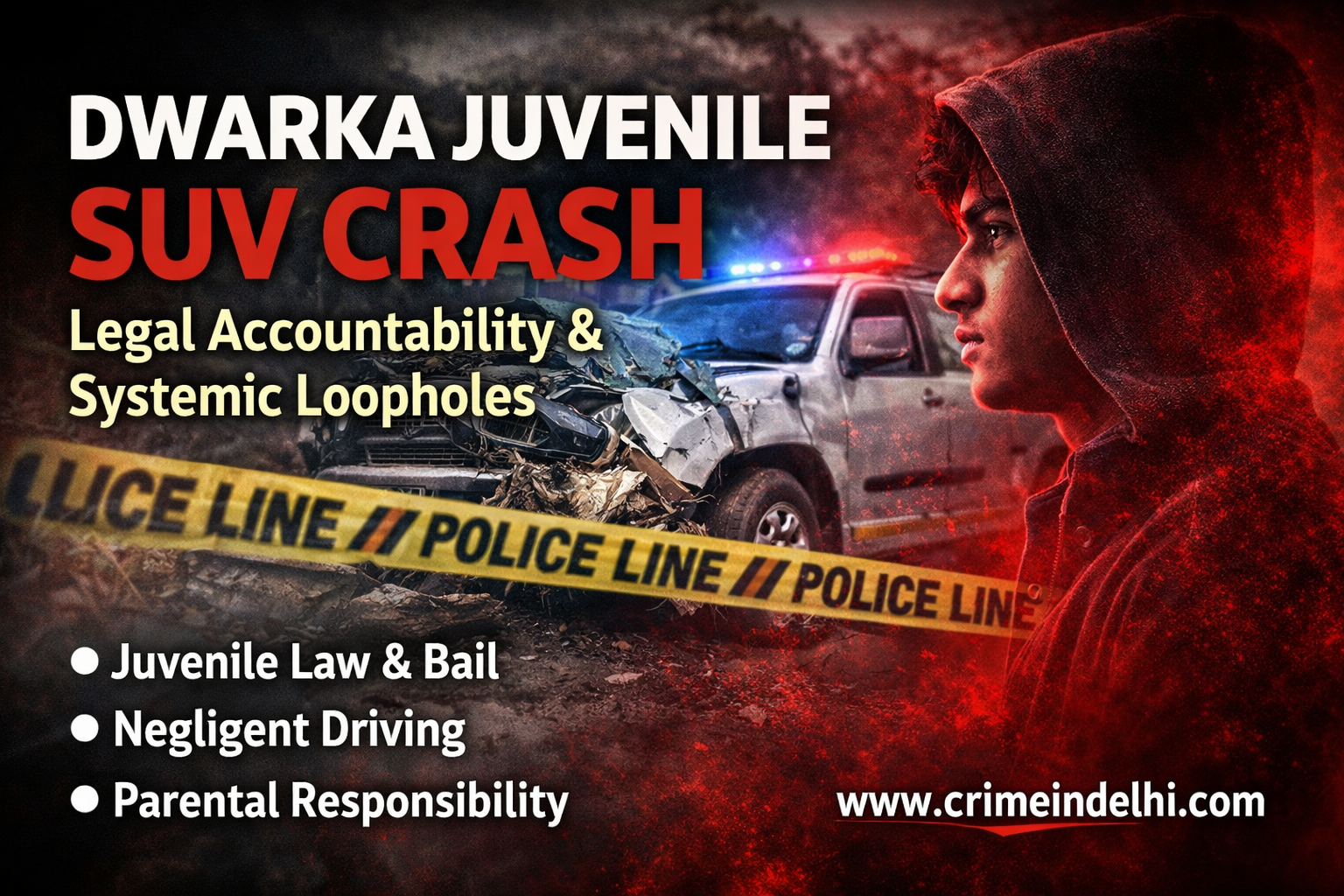
A tragic road accident in Dwarka involving a juvenile allegedly driving an SUV at high speed has once again raised serious legal and societal concerns. A 23-year-old lost his life, and CCTV footage reportedly captured the manner in which the vehicle was being driven. While the human loss is immeasurable, the legal questions emerging from this case are equally significant. The issue extends beyond one accident and touches upon criminal liability, juvenile justice, parental accountability, and systemic enforcement failures.
Criminal Liability Under the New Criminal Law
The offence of causing death by rash or negligent driving is now governed by the Bharatiya Nyaya Sanhita. Section 106 of the new code addresses causing death by negligence and prescribes punishment for rash and reckless conduct. Where excessive speed and conscious disregard for public safety are established, the gravity of the charge may increase depending on the factual matrix.
The Supreme Court in Alister Anthony Pareira v State of Maharashtra held that high-speed driving in densely populated areas, when accompanied by knowledge of likely fatal consequences, may in appropriate cases transcend mere negligence and approach culpable homicide. The distinction between simple negligence and knowledge-based recklessness is crucial in determining punishment.
The Juvenile Angle: Trial as Minor or Adult?
The matter falls within the framework of the Juvenile Justice (Care and Protection of Children) Act, 2015. If the accused is between 16 and 18 years of age and the alleged offence qualifies as “heinous” (punishable with seven years or more), the Juvenile Justice Board must conduct a preliminary assessment of mental and physical capacity before deciding whether the child should be tried as an adult.
In Shilpa Mittal v State of NCT of Delhi, the Supreme Court clarified the categorisation of offences under the Act and the scope of such preliminary assessment. Therefore, the outcome depends upon the nature of charges framed after investigation and the Board’s evaluation of intent, awareness, and capacity.
Parental and Owner Liability Under the Motor Vehicles Act
The Motor Vehicles Act, 1988, through Section 199A introduced in 2019, creates deemed liability for the guardian or owner when a minor commits a traffic offence. The provision prescribes imprisonment up to three years, a fine of ₹25,000, cancellation of vehicle registration, and disqualification of the minor from obtaining a driving licence until the age of 25.
This statutory shift reflects legislative recognition that underage driving often occurs with the knowledge or negligence of guardians. Where evidence shows conscious permission or habitual disregard, prosecution of parents is not merely symbolic but legally mandated.
Bail and the Debate Over Leniency
Under the Juvenile Justice Act, bail is generally the rule unless release would defeat the ends of justice or expose the child to danger. However, the gravity of road fatality cases has repeatedly drawn judicial scrutiny. In State of Punjab v Saurabh Bakshi, the Supreme Court emphasised that misplaced sympathy in cases of rash driving resulting in death undermines deterrence and public confidence.
The legal system must therefore strike a balance between reformative principles for juveniles and the need to uphold accountability where negligence results in irreversible harm.
Systemic Loopholes and Enforcement Concerns
Incidents involving minors driving high-end vehicles often highlight enforcement failures. Questions arise as to how such driving continues unchecked, whether earlier violations were ignored, and whether social or financial influence impacts initial police action. If investigation reveals that guardians knowingly allowed unlicensed driving, liability may extend beyond traffic offences to potential abetment or negligent conduct provisions under the penal law, subject to evidence.
Additionally, civil liability before the Motor Accident Claims Tribunal remains available to the victim’s family, ensuring compensation irrespective of criminal proceedings.
Role of Digital Evidence Under New Procedural Law
With the implementation of the Bharatiya Nagarik Suraksha Sanhita, reliance on electronic and digital evidence has gained stronger procedural backing. CCTV footage, forensic vehicle analysis, and speed reconstruction reports can significantly influence the evidentiary foundation of such cases. Modern criminal investigation increasingly depends on technological corroboration rather than solely on oral testimony.
Conclusion: Reform, Deterrence and Accountability
The Dwarka tragedy is not merely a road accident; it represents a test of legal enforcement in cases involving juvenile drivers and alleged privilege. The law today provides mechanisms for prosecuting rash and negligent driving, assessing juvenile culpability, holding guardians accountable, and awarding compensation. The true measure of justice, however, lies in consistent application without fear or favour.
Where speed, negligence, and systemic oversight intersect, accountability must remain visible to preserve public trust in the rule of law.
Frequently Asked Questions
Can a juvenile be tried as an adult in road accident cases?
Yes, if aged 16–18 and offence qualifies as heinous (7+ years punishment), after preliminary assessment.
What punishment do parents face if minor drives illegally?
Under Section 199A MV Act, parents can face 3 years imprisonment and fine.
Is causing death by rash driving a serious offence under BNS?
Yes, Section 106 BNS provides imprisonment and enhanced punishment for hit-and-run.
Does CCTV footage hold strong legal value?
Yes, digital evidence is admissible under Indian Evidence Act principles and new procedural reforms.
For more in-depth legal analysis and ground-level crime reporting, visit www.crimeindelhi.com.