

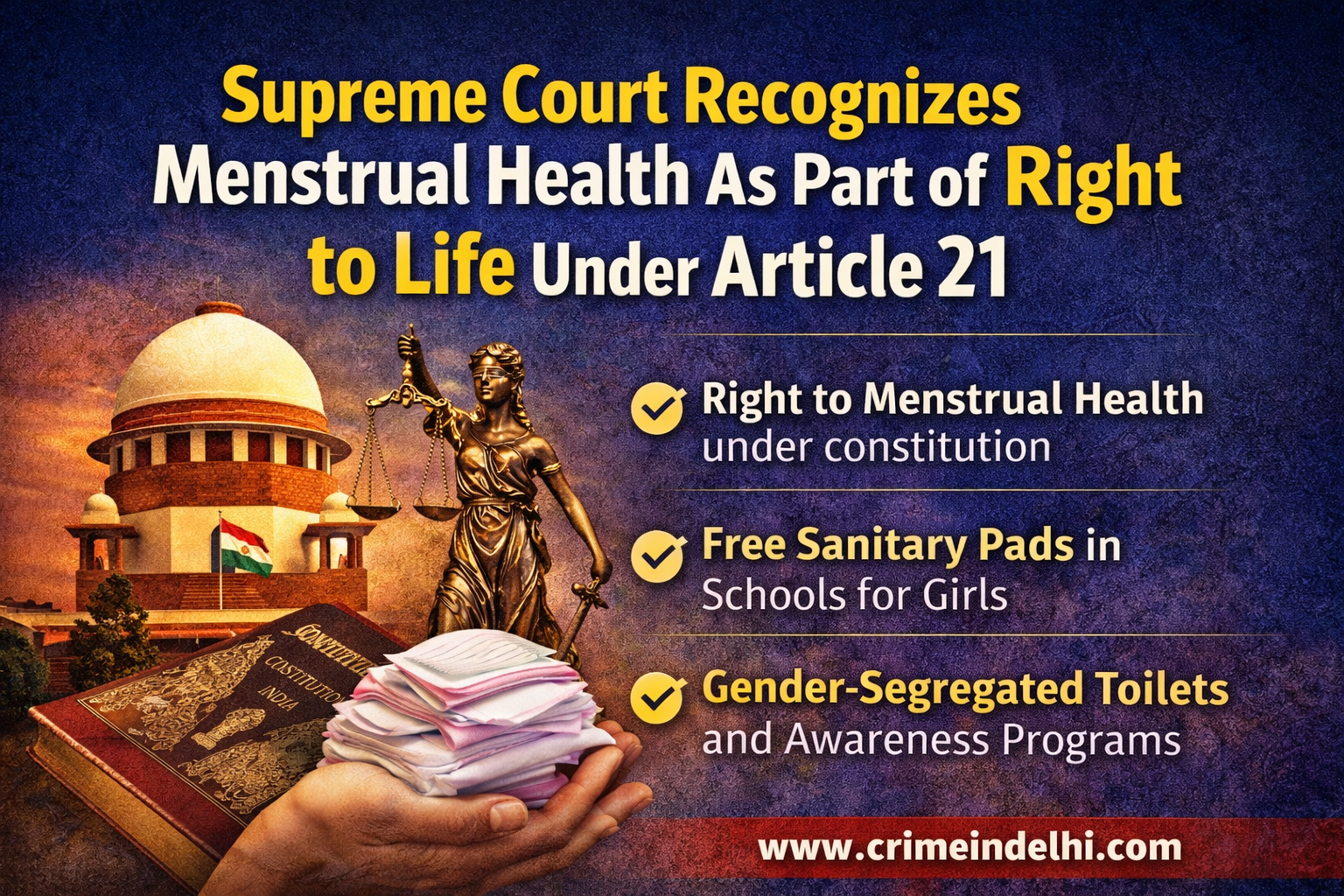
In a landmark constitutional development, the Supreme Court of India has unequivocally recognised that the right to menstrual health and hygiene forms an integral part of the right to life and personal dignity under Article 21 of the Constitution.
The judgment reinforces that denial of menstrual hygiene facilities amounts to a violation of fundamental rights, particularly of girl children and menstruating persons.
The ruling goes beyond declaratory relief and lays down binding, enforceable directions for States, Union Territories, and educational institutions, marking a significant shift from policy discretion to constitutional obligation.
A Bench of Justices JB Pardiwala and R. Mahadevan – “The right of menstrual health is part of the right to life under Article 21 of the Constitution. A girl child’s expectation to manage her menstruation in privacy with dignity is legitimate”.
“The SC has directed that Students from Classes 6 to 12 must be provided sanitary pads free of cost. These directions are applicable to all states as well as the Union of India, with a compliance report to be submitted within three months. Failure in compliance with its directions would result in the de-recognition of schools,” the Supreme Court said.
Constitutional Basis: Menstrual Health Within Article 21
Article 21 guarantees the right to life with dignity, bodily autonomy, health, and privacy. The Court held that:
-
Menstrual health is inseparable from physical health, mental well-being, education, and equality
-
Lack of access to sanitation and menstrual products leads to school dropouts, stigma, discrimination, and health risks
-
The State has a positive obligation to create enabling conditions for menstrual dignity
The Court relied on settled jurisprudence expanding Article 21 to include health, sanitation, and human dignity.
Key Supreme Court Directions on Menstrual Hygiene Management (MHM)
1. Mandatory Sanitation Infrastructure in Schools
The Court directed that all government and private schools, irrespective of management or location, must ensure:
-
Functional, gender-segregated toilets
-
Continuous water supply
-
Privacy-compliant sanitation facilities
-
Disability-inclusive access
-
Regular maintenance and hygiene audits
Failure to provide basic sanitation was held to be constitutionally impermissible.
2. Free Supply of Biodegradable Sanitary Napkins
The judgment mandates:
-
Free distribution of oxo-biodegradable sanitary napkins to students
-
Installation of vending machines or structured supply mechanisms
-
Uniform availability in rural, urban, and remote regions
The Court clarified that affordability cannot be a barrier to fundamental rights.
3. Establishment of Menstrual Hygiene Management (MHM) Corners
Every school must set up a dedicated MHM Corner containing:
-
Emergency sanitary absorbents
-
Spare uniforms or innerwear
-
Disposal bags
-
First-aid and hygiene essentials
These facilities aim to ensure that menstruating students are not forced to leave school or miss classes.
4. Scientific and Safe Disposal of Menstrual Waste
The Court ordered compliance with environmental and health standards by:
-
Installing covered disposal bins
-
Ensuring scientific waste management
-
Aligning disposal systems with Solid Waste Management Rules
Improper disposal was flagged as both a health hazard and environmental concern.
5. Curriculum Reform and Sensitisation Programmes
The Court directed NCERT and SCERT authorities to:
-
Integrate menstrual health education into school curricula
-
Include age-appropriate, gender-neutral awareness modules
-
Sensitise teachers, including male staff
-
Conduct periodic training programmes
Importantly, the judgment emphasised inclusion of boys and male educators to dismantle stigma and misinformation.
6. Monitoring, Enforcement, and Accountability
To ensure compliance, the Court introduced institutional oversight mechanisms:
-
Periodic inspections by District Education Officers (DEOs)
-
Anonymous student feedback mechanisms
-
Mandatory compliance reporting
-
De-recognition of non-compliant private schools under the RTE framework
The Court invoked the doctrine of continuing mandamus, retaining jurisdiction to monitor implementation.
Impact on Fundamental Rights
The judgment strengthens constitutional protections relating to: Right to health, Right to education, Right to equality and non-discrimination, Right to dignity and privacy.
It recognises menstruation as a public health and human rights issue, not a private or charitable concern.
Legal Significance of the Judgment
This ruling:
-
Converts welfare schemes into constitutional mandates
-
Imposes enforceable duties on States and institutions
-
Aligns Indian jurisprudence with international human rights standards
-
Provides a justiciable framework for challenging denial of menstrual hygiene facilities
Any failure to implement these directions may now attract judicial intervention and contempt proceedings.
Local Delhi Perspective
In Delhi, the judgment has direct implications for:
-
Government and private schools under the Directorate of Education
-
Municipal schools under MCD
-
Budgetary allocation for menstrual hygiene programmes
-
Inspection responsibilities of district-level education authorities
Non-compliance can be challenged before the Delhi High Court under Articles 226 and 227.
Frequently Asked Questions (FAQs)
Q1. Is menstrual health now a fundamental right?
Yes. The Supreme Court has recognised menstrual health as part of the right to life under Article 21.
Q2. Do private schools have to comply?
Yes. The directions apply to all schools, including private and unaided institutions.
Q3. Are free sanitary pads mandatory?
Yes. Schools must ensure free access to biodegradable sanitary napkins.
Q4. Can non-compliance be challenged in court?
Yes. Affected persons may approach High Courts for enforcement.
The Supreme Court’s recognition of menstrual health as a fundamental right under Article 21 marks a transformative moment in Indian constitutional law. By issuing detailed implementation directions, the Court has ensured that menstrual dignity is no longer dependent on policy goodwill but is constitutionally enforceable.
This judgment not only safeguards health and education but also affirms that dignity during menstruation is a matter of constitutional justice.
For more such news and updates: visit us at: CrimeInDelhi