

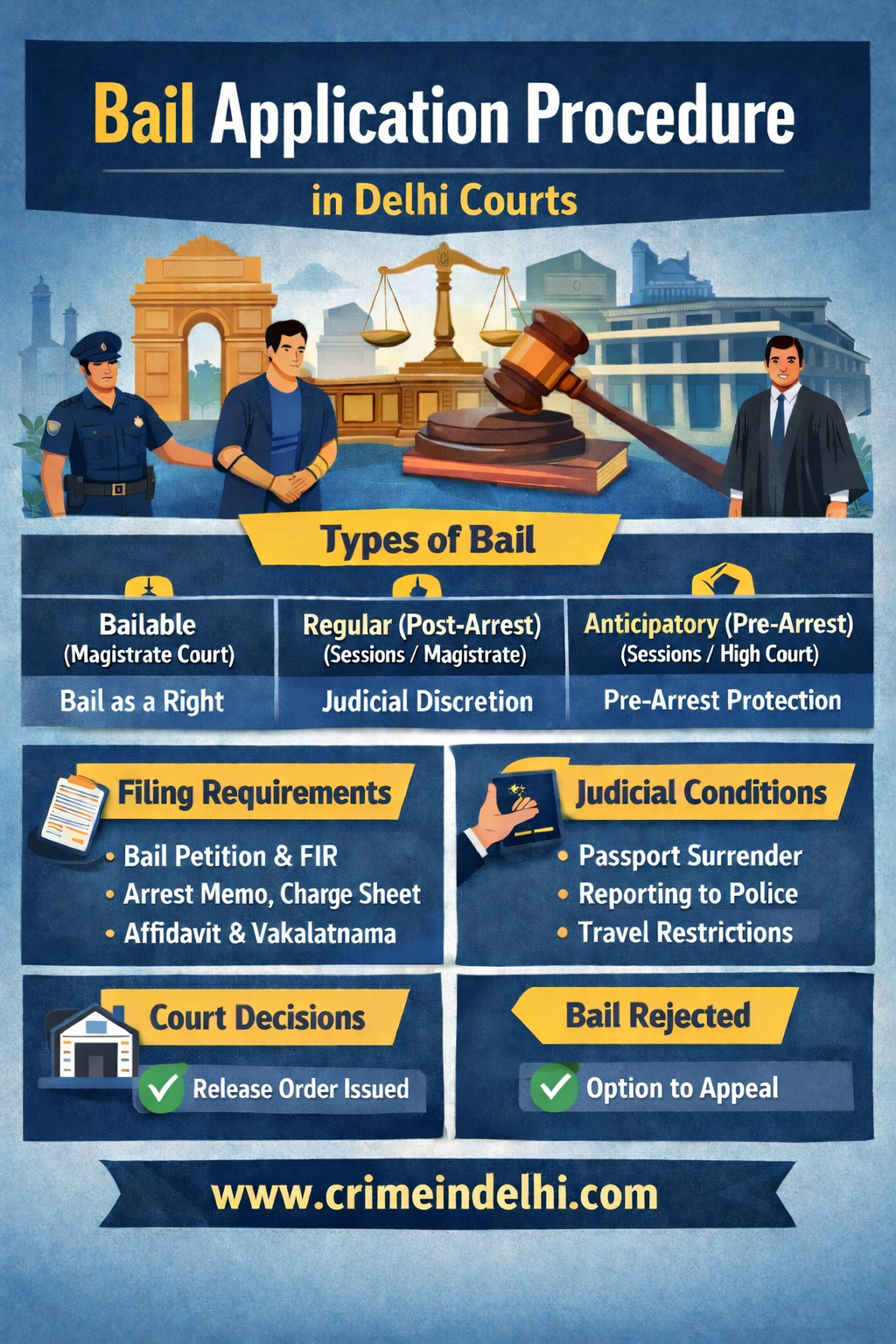
In the Delhi criminal justice system, bail applications—whether bailable, regular bail (post-arrest), or anticipatory bail (pre-arrest)—are processed through a structured judicial framework involving District Courts and the High Court of Delhi. This article explains how bail works in Delhi, covering the legal framework, court-wise jurisdiction, procedural steps, judicial considerations, and remedies, in line with current law and practice.
Applicable Legal Framework for Bail in Delhi
Historically, bail proceedings were governed by the Code of Criminal Procedure, 1973 (CrPC). With the enactment of the Bharatiya Nagarik Suraksha Sanhita, 2023 (BNSS), certain procedural and terminological changes have been introduced.
However, bail jurisprudence in Delhi continues to be guided by settled CrPC principles, particularly during the transitional phase. Courts routinely treat pending and fresh bail applications under CrPC provisions as valid, applying BNSS provisions where expressly notified.
Core Legal Principles Governing Bail
-
Bailable Offences: Bail is a statutory right, and denial is impermissible once conditions are fulfilled.
-
Non-Bailable Offences (Regular Bail): Grant of bail lies within judicial discretion, guided by: Gravity and nature of the offence, Severity of punishment, Possibility of absconding, Risk of tampering with evidence or influencing witnesses.
-
Anticipatory Bail (Pre-Arrest Bail)
Recognised through Section 438 CrPC or Section 482 of the Bharatiya Nagarik Suraksha Sanhita (BNSS) ,principles, protecting personal liberty against arbitrary arrest, subject to judicial safeguards.
Court-Wise Jurisdiction for Bail Applications in Delhi
Delhi District Courts
Delhi District Courts function across multiple complexes, including:
-
Tis Hazari (Central/North)
-
Saket (South)
-
Karkardooma (East/North-East)
-
Patiala House (New Delhi/South/SW)
-
Rohini (North-West)
-
Dwarka (South-West)
- Rouse Avenue court for specific matters (often handling corruption cases)
Each court exercises jurisdiction over specific police districts.
Jurisdiction by Bail Type
- Regular Bail (Non-Bailable): Magistrate Court: For less serious offences and Sessions Court: For serious or Sessions-triable offences
-
Anticipatory Bail: Sessions Court has concurrent jurisdiction with the High Court
High Court of Delhi
The Delhi High Court entertains bail matters in the following circumstances:
-
Anticipatory bail in exceptional or urgent cases
-
Appeals or revisions against Sessions Court orders
-
Regular bail where: Fundamental rights are implicated, if there is any illegality, procedural abuse, or miscarriage of justice or Inherent/writ jurisdiction is invoked
Judicial precedent confirms that an applicant may directly approach the High Court for anticipatory bail, though Sessions Court remains the usual first forum.
What to Do If Delhi Police Refuse to Register an FIR – Legal Remedies
Procedure for Filing Bail Applications in Delhi Courts
Filing Requirements: A standard bail application must include:
-
Properly drafted bail petition
-
Copy of FIR / complaint
-
Arrest memo (for regular bail)
-
Charge sheet (if filed)
-
Supporting affidavit
-
Vakalatnama
-
Relevant annexures and court fees
Applications are filed through the court filing counters or e-filing systems, after which the matter is listed in the computerised cause list.
Notice & Hearing Process
-
Notice is issued to the Public Prosecutor (PP) and Investigating Officer (IO)
-
During hearing:
-
Defence argues on liberty, merits, and legal safeguards
-
Prosecution opposes bail citing seriousness, investigation needs, or risks
-
Courts endeavour to decide bail matters expeditiously, especially where personal liberty is at stake.
Judicial Discretion & Bail Conditions
While deciding bail, courts balance:
-
Presumption of innocence
-
Right to personal liberty (Article 21)
-
Public interest and fair investigation
Common Bail Conditions
-
Execution of bail bond and surety
-
Surrender of passport
-
Travel restrictions
-
Periodic appearance before IO
-
Non-interference with witnesses or evidence
Violation of conditions may result in cancellation of bail.
Anticipatory Bail in Delhi: Special Considerations
Anticipatory bail protects individuals from pre-trial arrest in non-bailable cases.
Key aspects:
-
Can be filed before Sessions Court or High Court
-
Courts may grant: Interim protection, Final anticipatory bail with conditions, Cooperation with investigation is mandatory.
The Supreme Court of India has repeatedly emphasised that anticipatory bail applications should not be kept pending unnecessarily, and interim protection should not become punitive by delay.
Post-Order Compliance & Remedies
After Bail Is Granted
-
Certified copy of order is issued
-
Bail bond and sureties are furnished
-
Release orders are sent to jail or police authorities
-
Delay in release can be addressed through compliance applications
If Bail Is Rejected
Available remedies include:
-
Revision petition
-
Fresh bail application on changed circumstances
-
Appeal before the High Court
-
Invocation of inherent or constitutional remedies where warranted
Judicial Trends & Practice in Delhi
-
Bail applications filed under CrPC continue to be recognised under BNSS transitional provisions
-
Successive anticipatory bail applications on identical facts are discouraged unless material change is shown
-
Courts reiterate that “bail is the rule, jail is the exception”, particularly for undertrial prisoners
Reference Table: Bail in Delhi Courts
| Type of Bail | Court | Jurisdiction | Key Consideration |
|---|---|---|---|
| Bailable | Magistrate Court | Territorial | Bail as a matter of right |
| Regular (Post-Arrest) | Magistrate / Sessions | Territorial | Judicial discretion, risk assessment |
| Anticipatory | Sessions / High Court | Concurrent | Protection of liberty, seriousness of offence |
Understanding bail procedure in Delhi is essential for safeguarding personal liberty and ensuring procedural fairness. While statutory reforms under BNSS are evolving, Delhi courts continue to apply well-settled bail principles, with an increasing emphasis on expeditious disposal and proportional judicial discretion.
For more legal explainers, bail updates, and Delhi court practice insights, visit: www.crimeindelhi.com