

A “digital arrest” scam is when cheats call you pretending to be police, government officers or bank staff and say you are in big legal trouble. They keep you on a normal or video call, scare you with talk of “immediate arrest,” and then make you send them money so you don’t get “caught.”
The phrase “digital arrest” only sounds legal, but there is no such thing in Indian law. It is just a trick to frighten you and steal your money and personal details like bank numbers, OTPs, Aadhaar or PAN by showing fake IDs, fake notices and watching you continuously on video.
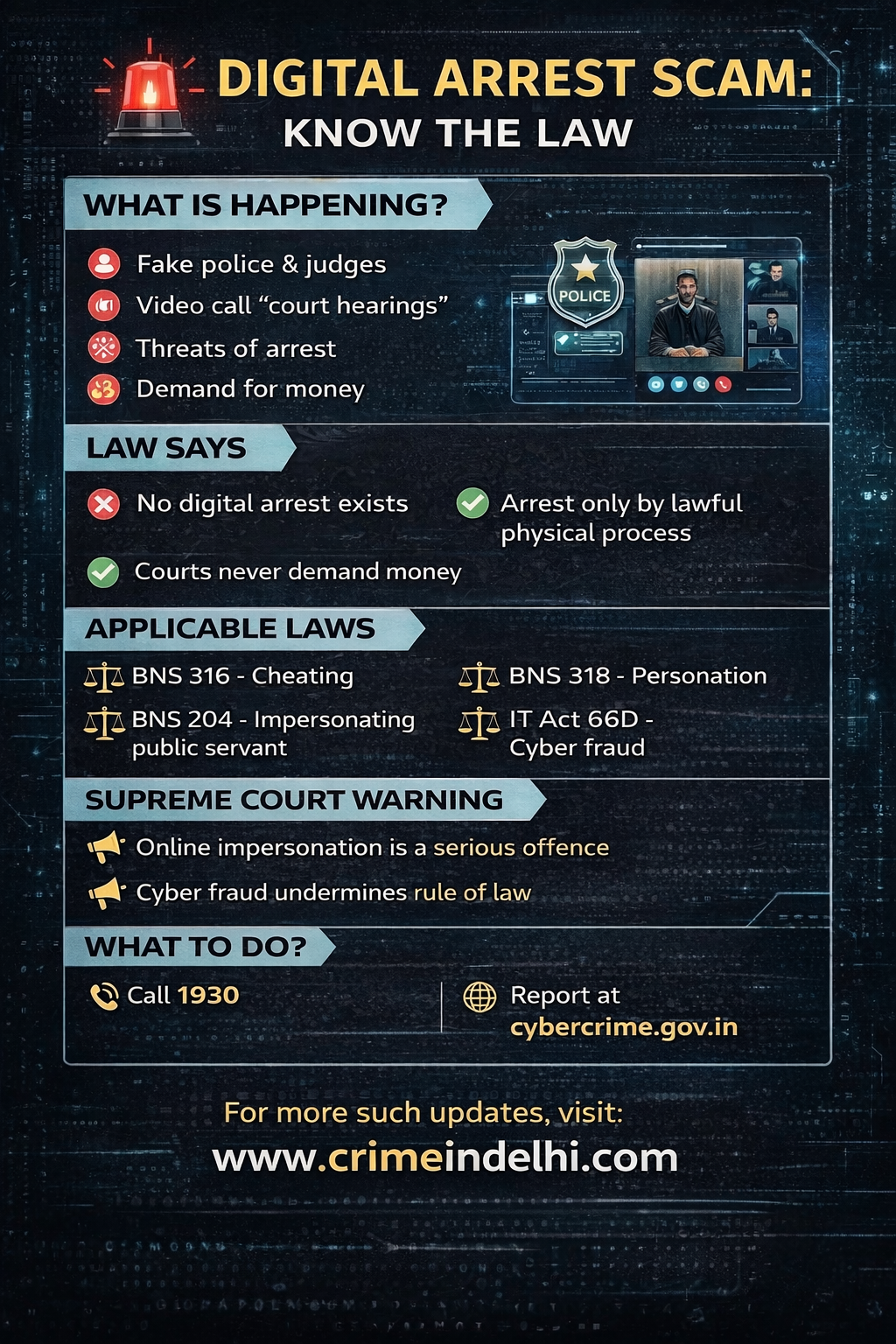
Digital arrest is not recognised under Indian law. A digital arrest scam is a form of organised cybercrime in which fraudsters:
-
Impersonate police officers, central agencies, or judges
-
Claim the victim is under investigation for serious offences
-
Conduct fake video calls resembling court proceedings
-
Demand money to “avoid arrest” or “settle the case”
Key Legal Facts on Digital Arrest
-
Arrests can only be made in accordance with law and through physical custody.
-
No judge or police officer conducts criminal proceedings over private video calls.
-
Any demand for money to close or verify a criminal case is illegal per se.
Latest News: Mumbai Woman Loses ₹3.71 Crore in ‘Digital Arrest”
Supreme Court on Cyber Fraud
The Supreme Court of India has, in multiple judgments and observations, expressed serious concern over the rise of cyber fraud and online impersonation:
-
The Court has noted that cyber fraud poses a direct threat to financial security and public confidence in institutions, and requires strict enforcement and public awareness.
-
It has emphasised that impersonation of public officials and misuse of digital platforms are grave offences that undermine the rule of law.
-
The Supreme Court has also repeatedly cautioned citizens that law-enforcement agencies and courts do not seek payments or conduct investigations through phone calls, video calls, or messaging applications.
The judiciary has urged both governments and citizens to enhance cyber awareness and ensure swift reporting of such offences.
Cybercrime Data: A Growing National Crisis
The Mumbai incident is part of a broader national trend:
-
Over 22.6 lakh cybercrime complaints were reported across India in 2024.
-
Financial losses due to cyber fraud exceeded ₹22,000 crore in the same year.
-
Digital arrest scams have emerged as one of the fastest-growing categories of cybercrime, with reported cases increasing more than threefold since 2022.
-
Senior citizens are among the most vulnerable victims due to fear of legal consequences and lower digital literacy.
The Ministry of Home Affairs, through the Indian Cybercrime Coordination Centre (I4C), has repeatedly issued advisories warning against scams involving impersonation of judges, CBI officers, ED officials, and police personnel.
Investigation and Penal Provisions
The cyber police are investigating offences relating to: Cheating, Criminal intimidation, Impersonation of public servants, Relevant offences under the Information Technology Act, 2000. Authorities are also tracing digital money trails to identify interstate and international cybercrime syndicates.
Applicable Offences Under Bharatiya Nyaya Sanhita, 2023 (BNS)
-
Section 316 BNS – Cheating and dishonestly inducing delivery of property
-
Section 318 BNS – Cheating by personation (impersonating police/judge)
-
Section 336 BNS – Forgery for the purpose of cheating
-
Section 338 BNS – Forged documents or electronic records
-
Section 351 BNS – Criminal intimidation
-
Section 204 BNS – Personating a public servant
Information Technology Act, 2000 may apply, including:
-
Section 66D – Cheating by personation using computer resources
Supreme Court & Judicial Observations on Cybercrime – Related Case Laws:
Shreya Singhal v. Union of India (2015)
The Supreme Court recognised the serious misuse of digital platforms for criminal activities and emphasised the need for balancing technology with legal safeguards.
State of Gujarat v. Mohanlal Jitamalji Porwal (1987)
The Court observed that economic offences corrode public confidence and must be dealt with sternly — a principle consistently applied to cyber fraud cases.
NASSCOM v. Ajay Sood (Delhi High Court)
The Court recognised online impersonation and phishing as actionable cyber offences, holding that deception using electronic means attracts criminal liability.
Supreme Court Observations in Cyber Fraud Matters
The Court has repeatedly clarified that:
-
Law-enforcement agencies do not demand money over calls or video conferencing
-
Judicial authorities do not conduct trials or issue arrest directions online
-
Public awareness is essential to curb cybercrime
Citizens are advised to remember:
-
There is no concept of digital arrest under Indian law.
-
The Chief Justice of India, judges, or police officials never contact individuals directly for criminal investigations.
-
Any such call must be treated as a cybercrime and immediately reported to the Cybercrime Helpline 1930 or www.cybercrime.gov.in.