
Bail applications in Delhi courts are primarily governed by the Code of Criminal Procedure, 1973 (CrPC), now in the Bharatiya Nagarik Suraksha Sanhita, 2023 (BNSS).
This article provides a step-by-step drafting and filing guide for bail matters before Magistrate Courts, Sessions Courts, and the Delhi High Court.
1. Before Drafting the Bail Application
Obtain Complete Case Particulars
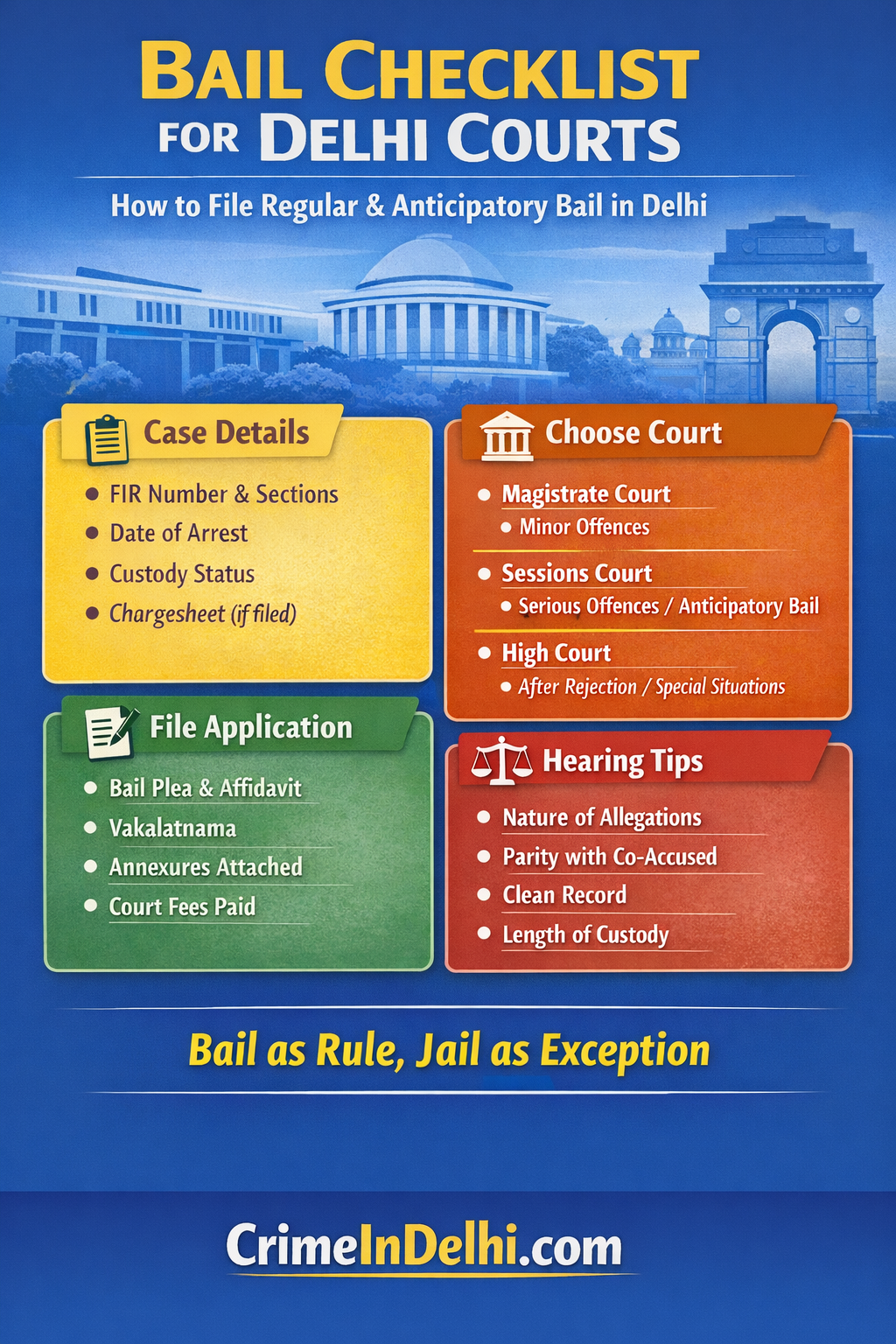
Ensure absolute accuracy of foundational details, including: FIR Number and Date, Police Station, Sections invoked (IPC / BNS / Special Statute such as NDPS, POCSO, IT Act, etc.), Date of arrest (or apprehension in anticipatory bail), Present custody status (Police Custody / Judicial Custody / Not arrested).
Case Law: D.K. Basu v. State of West Bengal (1997) – Arrest procedure safeguards must be strictly followed.
Stage of proceedings: Investigation pending, Chargesheet filed, Trial stage
Collect and Verify Supporting Documents
Maintain a complete paper-book, including: Copy of FIR, Arrest memo and remand order, Medical documents (injury, illness, hospitalisation, MLC), Chargesheet (if filed), Previous bail orders (regular / interim / anticipatory, if any), Status report (if supplied earlier by IO).
Non-filing of relevant remand orders often results in adjournments in Delhi courts.
Correct Jurisdiction
Jurisdictional error can render the application non-maintainable.
-
Magistrate Court: Bailable offences and Non-bailable offences triable by Magistrate
-
Sessions Court: Serious non-bailable offences and Anticipatory bail under Section 438 CrPC / BNSS equivalent
-
Delhi High Court: Bail after rejection by lower courts and in Exceptional circumstances (constitutional grounds, prolonged custody, violation of Article 21)
Anticipatory bail is a device to secure individual liberty.: Case Law – Gurbaksh Singh Sibbia v State of Punjab (1980)
2. Filing Checklist (Delhi Court Practice)
Before filing, ensure the application complies with procedural norms:
-
Proper cause title mentioning FIR, PS, sections, and court
-
Clear statement of custody status on the first page
-
Detailed bail application with numbered paragraphs
-
Supporting affidavit of the accused or authorised family member
-
Vakalatnama duly signed and stamped
-
Annexures indexed, paginated, and legible
-
Proof of service upon APP/Prosecution
-
Clearly worded prayer clause (regular / interim / anticipatory bail)
-
Court fees affixed, where applicable
In Delhi Courts custody status be highlighted at the top of the bail application.
Case Law: Hussainara Khatoon v. State of Bihar (1979) – Right to speedy justice includes consideration of bail.
3. Hearing Checklist – Arguments Preparation
At the time of hearing, be fully prepared to address the following:
Considerations by Courts at the time of Bail Hearing
-
Nature and gravity of allegations
-
Specific role attributed to the accused
-
Requirement of custodial interrogation
-
Recovery already effected or pending
-
Stage of investigation
Case Law: State of Rajasthan v. Balchand(1977) – Bail as Rule, Jail as Exception
Mitigating(Diminishing) Factors to Highlight
-
Parity with co-accused already on bail
-
Clean antecedents / no prior criminal history
-
Length of judicial custody
-
Filing of chargesheet (if applicable)
-
Cooperation with investigation
Case Law: Sanjay Chandra v. CBI (2012) – Detention should not become punitive before conviction.
Practical Hearing Tip
If bail is likely to be granted: Keep surety documents ready in advance, Ensure surety meets local court requirements, Verify address proof and ID of surety.
These helps in avoid unnecessary delay in release.
Conclusion
A well-drafted bail application is not merely a formality but a strategic legal document grounded in facts, procedure, and constitutional liberty under Article 21. Precision in drafting, procedural compliance, and reliance on settled Supreme Court jurisprudence significantly improve success before Delhi courts. Adhering to this checklist significantly enhances the prospects of effective representation before Delhi courts.
For more such articles visit: CrimeInDelhi