

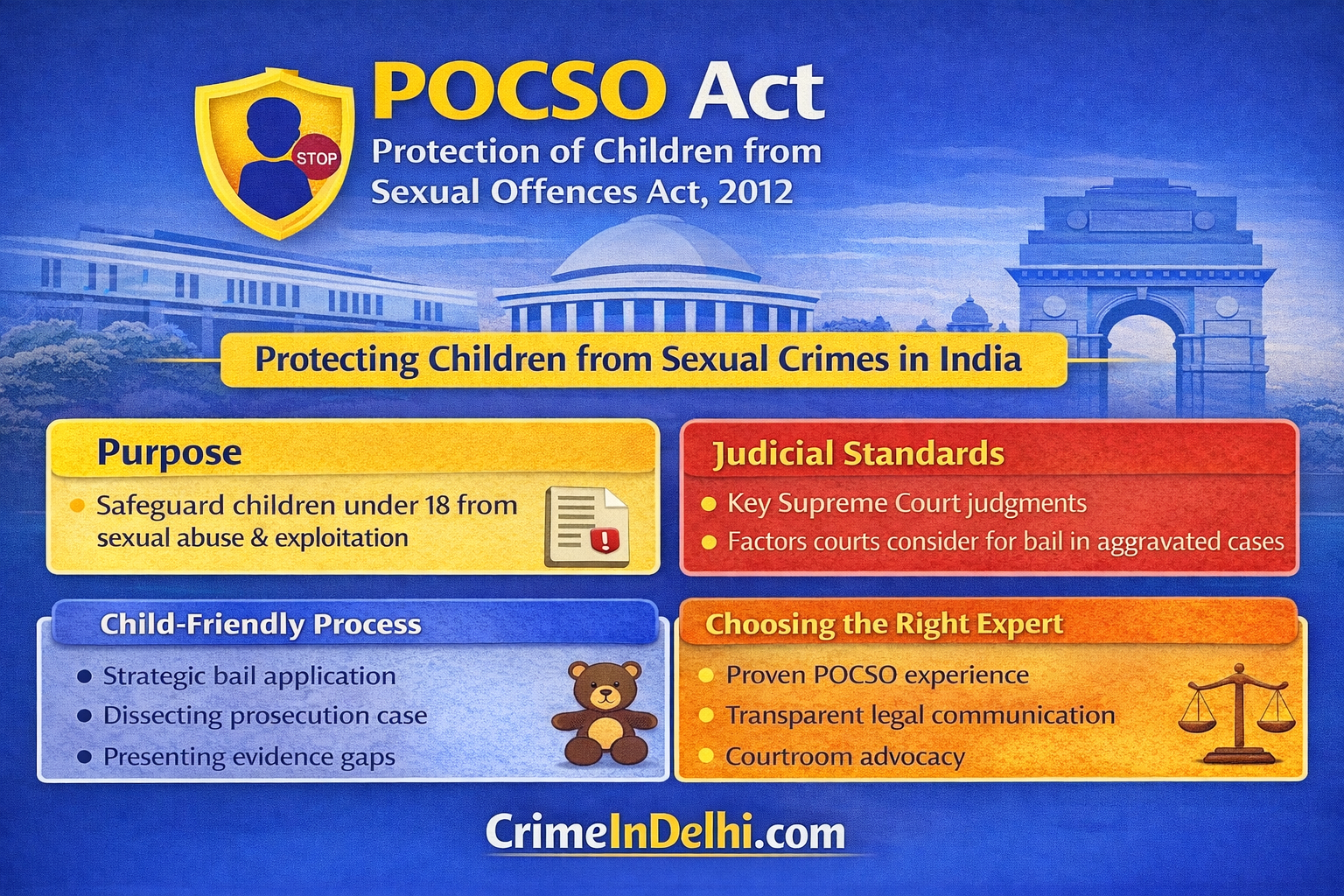
The Protection of Children from Sexual Offences Act, 2012 (POCSO Act) is a special criminal law enacted to protect children from sexual abuse, exploitation, and sexual violence. While the Act prescribes stringent punishments and procedural safeguards for child victims, it does not create a statutory embargo on bail.
Bail under POCSO is governed by a heightened judicial threshold, constitutional liberty under Article 21, and general criminal procedure principles now codified under the Bharatiya Nagarik Suraksha Sanhita, 2023 (BNSS).
This article helps you to understand the various aspects of the POCSO Act:
- The POCSO Act
- The legal position on bail under the POCSO Act
- Judicial standards and key case law
- The role of defence lawyers in bail strategy
- How to choose the best legal expert in a POCSO bail matter
What is the POCSO Act, and why does it matter?
The POCSO Act was enacted to protect children from sexual offences. In this act, it is the duty of the State to create child-friendly investigation and trial procedures. Establish Special Courts for speedy adjudication and prevent secondary victimisation.
The object of the POCSO Act is to impose deterrent punishment for sexual crimes against minors.
The Act recognises children as a vulnerable class requiring enhanced statutory protection.
Who is a “Child” under the POCSO Act?
Section 2(d), POCSO Act – A “child” means any person below 18 years. Even a minor’s consent is legally irrelevant under the Act.
Types of Offences Under the POCSO Act
| Section | Offence |
| Section 3 | Penetrative sexual assault |
| Section 5 | Aggravated penetrative sexual assault |
| Section 7 | Sexual assault |
| Section 9 | Aggravated sexual assault |
| Section 11 | Sexual harassment |
| Section 13 | Use of child for pornographic purposes |
Punishments range from a minimum 3 years to life imprisonment or death in aggravated cases.
Cognizable and Non-Bailable Nature of POCSO Offences
Section 19, POCSO Act – All offences under POCSO are cognizable.
Section 31, POCSO Act – The provisions of criminal procedure (now BNSS) apply to proceedings before Special Courts unless inconsistent with the Act.
All POCSO offences are procedurally non-bailable, meaning bail is discretionary and not a matter of right.
POCSO and Bail — Statutory Position (BNSS 2023)
Does the POCSO Act Bar Bail?
No. The POCSO Act does not contain any express prohibition against granting bail.
Section 31 of the POCSO Act: General criminal procedure applies. Section 483, BNSS 2023: (Formerly Section 439 CrPC) – Empowers the High Court and Sessions Court to grant bail.
Are POCSO Offences Bailable or Non-Bailable?
All POCSO offences are non-bailable, meaning:
- Bail is not automatic
- Judicial discretion applies
- Courts must record reasons
- Victim protection is a paramount consideration
However, non-bailable does not mean non-grantable.
Judicial Approach to Bail in POCSO Cases
Courts follow a balanced constitutional approach, weighing these points:
- Protection of the child
- Presumption of innocence
- Personal liberty under Article 21
- Evidentiary strength
- Risk of witness intimidation
Supreme Court Principles and Judgements on Bail
Sanjay Chandra v. CBI (2012) – “Bail is the rule, jail is the exception.”
State of Rajasthan v. Balchand (1977) – Personal liberty cannot be lightly curtailed.
Satender Kumar Antil v. CBI (2021) – Arrest and detention must satisfy proportionality.
Important Case Law on POCSO Bail
Deshraj @ Musa v. State of Rajasthan & Anr (2024, Supreme Court)
- Accused (18) and prosecutrix (16) in a consensual relationship
- Prolonged custody
- No flight risk
Held: Bail granted. Liberty cannot be sacrificed merely due to the technical application of POCSO.
Pratap v. State of Himachal Pradesh (HP High Court)
Held: POCSO Act does not impose a special bar on bail. General bail principles apply.
Mahipal v. Rajesh Kumar (2020)
Held: Bail orders must reflect judicial application of mind.
Gurbaksh Singh Sibbia v. State of Punjab (1980)
Held: Anticipatory bail protects personal liberty. No blanket exclusion.
Anticipatory Bail in POCSO Cases
No law under the POCSO Act completely stops a person from seeking anticipatory bail.
Courts can grant such bail in suitable POCSO cases, especially where the facts do not show an immediate need to arrest the accused. For example, courts may consider anticipatory bail where the FIR has been filed after a long delay, where the allegations appear exaggerated or doubtful, or where the case involves a consensual teenage relationship. If the accused has no past criminal record and the police do not genuinely require custody for investigation, courts are more inclined to protect the person from arrest.
Ultimately, the decision depends on the facts of each case, but anticipatory bail is legally permissible in POCSO matters.
Factors Courts Consider in Granting Bail in POCSO Cases
When a court decides whether to grant bail in a POCSO case, it carefully looks at several important factors. The judge examines whether the allegations appear strong at first glance or seem doubtful. Medical and forensic reports are checked to see if they support the version given by the victim. The court also considers how believable and consistent the victim’s statement is. If there is an unusual delay in filing the FIR, that can raise questions about the case. The age difference between the accused and the child is also relevant, especially in teenage relationship cases.
Courts further assess whether the accused might try to influence witnesses, tamper with evidence, or run away if released on bail. If any co-accused have already been granted bail in similar circumstances, that is also considered.
Finally, the court considers whether keeping the accused in custody is truly necessary for investigation or whether the case can proceed without arrest.
Bail Conditions Commonly Imposed in POCSO Matters
When a court grants bail in a POCSO case, it usually puts certain conditions in place to ensure the safety of the child and the fairness of the investigation. The accused may be directed not to contact the victim or the victim’s family in any manner. In many cases, the court also restricts the accused from entering the locality where the victim lives.
The accused may be asked to surrender their passport to prevent leaving the country. Courts often require the accused to appear regularly before the Investigating Officer as directed. Travel outside the city or state may be restricted without prior court permission. In addition, the accused must furnish a bail bond and surety, meaning a responsible person must guarantee their presence in court whenever required.
How Defence Lawyers Approach POCSO Bail Applications
When a lawyer applies for bail in a POCSO case, it is not just about filing papers. It requires careful study of the case and clear legal reasoning. In simple words, a defence lawyer usually does the following:
- Carefully reads the FIR, the victim’s statement, and the medical report to understand what exactly is alleged.
- Looks for contradictions or mistakes in the police investigation or in the statements on record.
- Checks whether keeping the accused in jail is necessary for the investigation.
- Examines the victim’s age records to see if there is any doubt or inconsistency.
- Points out signs that the relationship, if any, was mutual (where legally relevant).
- Questions the delays in filing the FIR and asks why the complaint was not made earlier.
- Argues that long jail custody before trial is unfair and excessive.
- Builds strong and lawful grounds for bail instead of vague or emotional arguments.
- Reminds the court that personal liberty is a constitutional right and jail should be the last option, not the first.
In short, a defence lawyer focuses on facts, legal safeguards, and fairness, not just technicalities, while seeking bail in POCSO matters.
A reasoned bail application is grounded in evidence, precedent, and judicial proportionality, not mere emotional appeal.
Choosing the Right Defence Lawyer for a POCSO Bail Case
Selecting competent legal representation in a POCSO bail matter is critical.
A suitable legal expert should demonstrate:
- Proven Experience in POCSO Litigation – Prior handling of POCSO bail matters and familiarity with Special Court practice.
- Sound Understanding of Bail Jurisprudence – Ability to argue constitutional liberty, evidentiary insufficiency, and custodial necessity.
- Transparency and Communication – Clear explanation of procedural stages, risks, and realistic outcomes.
- Ethical and Professional Conduct – Sensitivity toward victims, responsible advocacy, and procedural integrity.
- Courtroom Advocacy Skills – Capacity to argue effectively before Sessions Courts and High Courts.
Regular Bail (After Arrest)
When a person has already been arrested in a POCSO case, the lawyer follows these basic steps:
- Files a bail application before the Special POCSO Court or the Sessions Court.
- Gives a copy of the bail application to the Public Prosecutor (PP) and the Investigating Officer.
- Explains to the court why keeping the accused in jail is not necessary for the investigation.
- Points out contradictions in the case and any delay in filing the complaint.
- Assures the court that the accused will not harm or influence the victim and will follow all conditions imposed by the court.
Anticipatory Bail (Before Arrest)
When person fears arrest in a POCSO case, the lawyer applies for anticipatory bail. In simple terms, this involves:
- Applying the BNSS provision equivalent to Section 438 of the old CrPC.
- Showing the court that there is a genuine fear of being arrested.
- Pointing out weaknesses in the case at the initial stage itself.
- Promising full cooperation with the police during the investigation.
In short, whether it is regular bail or anticipatory bail, the focus is on fairness, the necessity of custody, and protecting the rights of the accused while ensuring the investigation is not affected.
FAQs on POCSO Bail
Is bail possible in a POCSO case?
Yes. Bail is discretionary but not barred.
Is anticipatory bail available in POCSO cases?
Yes. There is no statutory prohibition.
Are all POCSO offences non-bailable?
Yes, procedurally non-bailable.
Does victim consent matter?
No. Consent of a minor is legally irrelevant.
Can juveniles accused under POCSO get bail?
Yes, governed by the JJ Act.
Conclusion — Balancing Child Protection with Constitutional Liberty
The POCSO Act is a protective statute, but it does not eclipse constitutional liberty or established bail jurisprudence. While courts exercise heightened caution in granting bail, detention cannot be mechanical or punitive.
Bail in POCSO cases remains legally available based on:
- Evidentiary assessment
- Proportionality
- Custodial necessity
- Judicial discretion
A carefully structured bail application, grounded in statutory law and binding precedent, remains the cornerstone of securing liberty under the POCSO regime.
For suggestion or guidance in any case, feel free to contact CrimeInDelhi