

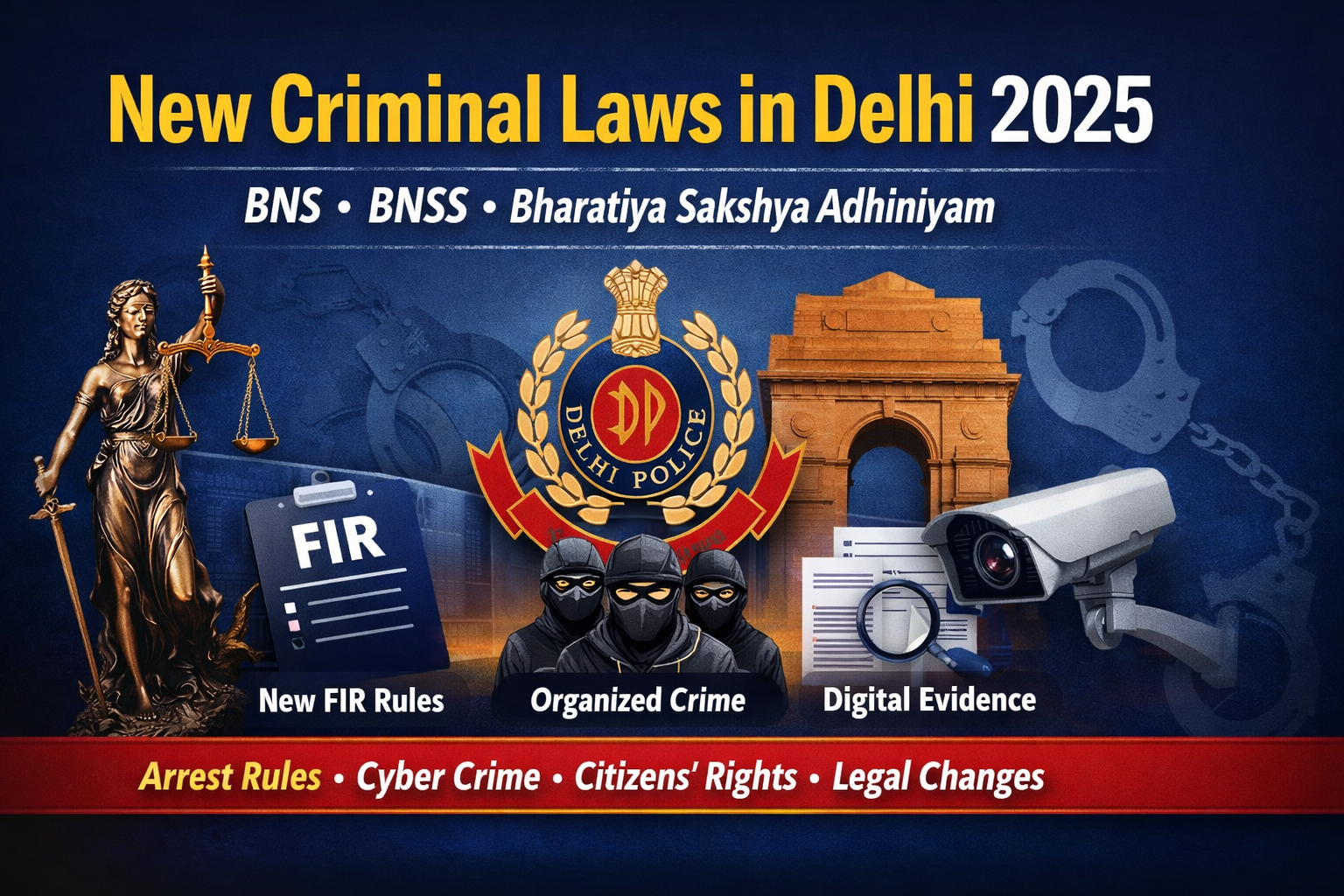
India’s IPC and CrPC have been replaced by BNS, BNSS, and BSA. Here’s what Delhi residents must know:
India’s criminal justice system has undergone its biggest transformation since Independence. The Indian Penal Code, 1860 (IPC), the Code of Criminal Procedure, 1973 (CrPC), and the Indian Evidence Act, 1872 have now been replaced by:
-
Bharatiya Nyaya Sanhita, 2023 (BNS)
-
Bharatiya Nagarik Suraksha Sanhita, 2023 (BNSS)
-
Bharatiya Sakshya Adhiniyam, 2023 (BSA)
These laws are now being implemented across Delhi and throughout India, and all FIRs are being registered under the new legal framework. Here is a complete, practical guide explaining what has changed and how it affects Delhi residents.
Why Were the Old Criminal Laws Replaced?
The government stated that the objective of replacing IPC and CrPC was to modernize criminal law, which incorporates digital and forensic realities. This helps in addressing organized crime and terrorism explicitly, with streamlined investigation timelines. This promotes victim-centric justice.
While the structure remains similar in many areas, several key provisions significantly impact citizens and law enforcement in Delhi.
Major Changes Under Bharatiya Nyaya Sanhita (BNS), 2023
- Organized Crime Now Defined
Unlike the IPC, the BNS introduces specific provisions dealing with organized crime and criminal syndicates.
This is particularly relevant in Delhi-NCR, where gang-based crimes, extortion networks, and interstate criminal syndicates operate. The inclusion strengthens prosecution powers against habitual and structured criminal networks.
Community Service as Punishment
For certain minor offences, courts can now award community service as a punishment.
Example: Earlier, a minor public nuisance case might have resulted in a fine or short imprisonment. Now, courts may direct supervised community service.
This reflects a reformative approach in minor cases.
Stricter Provisions for Crimes Against Women and Children
Certain offences relating to sexual crimes have been reorganized and strengthened.
The Supreme Court in State of Punjab v. Gurmit Singh, (1996) 2 SCC 384, had emphasized victim protection and sensitivity in sexual offence trials. The new framework continues to move toward victim-centric safeguards.
Mob Lynching & Terror-Related Provisions
The BNS introduces clearer recognition of mob violence and acts endangering sovereignty.
The Supreme Court in Tehseen Poonawalla v. Union of India, (2018) 9 SCC 501, had earlier directed states to curb mob lynching through preventive and remedial measures. The legislative shift reflects that judicial concern.
Major Procedural Changes Under BNSS, 2023
Videography of Search and Seizure
Search and seizure processes now require greater documentation and videography in many cases.
This reduces:
- Fabrication allegations
- Evidence tampering
- Procedural abuse
It enhances transparency in police action.
Time-Bound Investigation
BNSS introduces clearer timelines for the investigation and filing of charge sheets.
Delay in criminal trials has been repeatedly criticized by courts. In Hussainara Khatoon v. State of Bihar, (1979) AIR 1360, the Supreme Court held that a speedy trial is part of Article 21. The new framework attempts procedural discipline.
Expansion of E-FIR
E-FIR mechanisms are being expanded for certain categories of offences.
Delhi Police has already implemented online reporting in various matters. The new law institutionalizes digital filing systems further.
For a detailed guide on Zero FIR and how it works in Delhi, read our explainer here
Arrest Safeguards Continue
Although renumbered, the principles from D.K. Basu v. State of West Bengal, (1997) 1 SCC 416 continue to govern arrests:
- Arrest memo mandatory
- Informing relative/friend
- Medical examination
- Right to legal counsel
These safeguards remain constitutionally protected.
Arrest Is Now the Exception, Not the Rule
Bharatiya Sakshya Adhiniyam, 2023 – Evidence Law Changes
Electronic Evidence Recognition
Digital records, electronic communication, CCTV footage, and forensic data are more clearly integrated into admissibility rules.
In modern Delhi, crimes involving cyber fraud, WhatsApp chats, email trails, and UPI transactions have practical importance.
If you are facing online fraud, read our step-by-step guide on how to file a cyber crime complaint in Delhi
Forensic Strengthening
Greater emphasis on forensic examination aims to reduce reliance solely on oral testimony.
This aligns with judicial concerns about evidentiary reliability.
Example: Theft Case – 2022 vs 2025
A mobile phone was stolen in a Delhi Metro station.
Under IPC (Earlier):
- FIR under Section 379 IPC
- Investigation under CrPC u/s 154 & 156CrPC
- Traditional seizure documentation under Sections 100 & 102 CrPC
Under BNS (Now):
- FIR under Section 303 BNS
- Investigation under Section 173 & 176 BNSS
- Seizure and documentation under Section 185 BNSS
- Enhanced admissibility of electronic evidence under Bharatiya Sakshya Adhiniyam
The offence remains similar in nature, but procedural documentation and digital evidence handling are more structured.
What Is a ‘Digital Arrest’ Scam?
What Delhi Residents Should Know
If you are filing an FIR:
- Police must register FIR in cognizable offences.
- Refusal can be challenged before senior officers or a magistrate.
If arrested:
- You have the right to legal counsel.
- Family must be informed.
- Arrest memo is mandatory.
If you are a victim of Cyber Fraud:
- Preserve screenshots and transaction IDs.
- Report immediately through cyber portals and police stations.
- Digital evidence now has clearer statutory backing.
What Has Not Changed?
- Presumption of innocence
- Burden of proof on prosecution
- Right to bail (subject to offence category)
- Constitutional protections under Articles 20 and 21
The Supreme Court’s jurisprudence on fair trial, due process, and personal liberty continues to apply fully.
IPC vs BNS: What Has Changed in India’s Criminal Law?
Below is a simplified comparison between the Indian Penal Code, 1860 (IPC), and the Bharatiya Nyaya Sanhita, 2023 (BNS) to help Delhi citizens understand the key differences.
IPC vs BNS Comparison
| Aspect | Indian Penal Code (IPC), 1860 | Bharatiya Nyaya Sanhita (BNS), 2023 | What It Means for Citizens |
| Year & Origin | Enacted in 1860 during British rule | Enforced in 2024 replacing IPC | Modernised criminal law framework |
| Structure | 511 Sections | Reduced & reorganised sections | Streamlined drafting, similar core offences |
| Organised Crime | No specific standalone definition | Specific provisions addressing organised crime & criminal syndicates | Stronger action against gang networks |
| Mob Lynching | No specific section; dealt under murder/rioting | Explicit provisions addressing mob violence | Clearer legal accountability |
| Community Service | Not recognised as punishment | Introduced for certain minor offences | Reform-based punishment for minor crimes |
| Crimes Against Women | Defined but scattered provisions | Reorganised & strengthened provisions | Enhanced clarity and victim protection |
| Terror & Sovereignty Offences | Spread across various provisions | Structured approach under national security framework | Consolidated legal approach |
| Electronic Evidence (Linked with Evidence Act) | IPC not aligned with digital expansion | Integrated approach with new Evidence Law | Better handling of cyber and digital crimes |
| Snatching Offence | Not separately defined | Snatching recognised as specific offence | Faster prosecution in street crimes |
| Language & Terminology | Colonial terminology | Simplified and Indianised language | Easier public understanding |
CrPC vs BNSS – Procedural Changes
Since procedure affects citizens directly, here is a quick procedural comparison:
| Aspect | CrPC, 1973 | BNSS, 2023 | Impact on Public |
| Arrest Procedures | Established safeguards | Safeguards retained with structured documentation | Greater accountability |
| E-FIR | Limited statutory clarity | Expanded and formalised | Easier complaint filing |
| Videography of Search & Seizure | Not mandatory in most cases | Increased emphasis on recording | Reduces misuse |
| Investigation Timelines | Often flexible | Clearer time-bound structure | Faster justice expectation |
| Forensic Integration | Limited mandatory requirement | Greater forensic emphasis | Scientific investigation |
Evidence Law: Old vs New
| Aspect | Indian Evidence Act, 1872 | Bharatiya Sakshya Adhiniyam, 2023 |
| Electronic Records | Recognised via amendments | More clearly structured digital admissibility |
| Digital Communication | Evolved through court rulings | Integrated into statutory language |
| Forensic Evidence | Accepted but less structured | Greater procedural emphasis |
Example for Delhi Citizens:
Situation: A chain snatching case in West Delhi.
- Under IPC: Treated under robbery or theft provisions.
- Under BNS: Snatching is defined separately, enabling focused prosecution.
- Under BNSS: Investigation may include videographed recovery and digital evidence preservation.
This ensures stronger documentation and prosecution.
Important points for Citizens
✔ Core criminal principles remain unchanged
✔ Citizen rights under Article 21 remain protected
✔ Arrest safeguards continue
✔ Digital evidence and organised crime enforcement strengthened
✔ More structured investigation procedures
The transition from IPC to BNS is evolutionary, not revolutionary, but it modernises India’s criminal law system.
The replacement of IPC and CrPC with BNS and BNSS marks a historic legal transition. While many core principles remain intact, the new laws emphasize:
- Organized crime control
- Digital evidence integration
- Procedural transparency
- Victim-centric justice
For Delhi residents, understanding these changes is essential — whether you are filing a complaint, facing investigation, or simply seeking awareness of your rights.
The criminal justice system has evolved. Citizens must evolve with it.
Frequently Asked Questions (FAQs)
1. What are the new criminal laws that replaced IPC and CrPC?
The Indian Penal Code (IPC), 1860, the Code of Criminal Procedure (CrPC), 1973, and the Indian Evidence Act, 1872 have been replaced by the Bharatiya Nyaya Sanhita (BNS), 2023, the Bharatiya Nagarik Suraksha Sanhita (BNSS), 2023, and the Bharatiya Sakshya Adhiniyam, 2023. These laws aim to modernize India’s criminal justice system.
2. When did the new criminal laws come into effect?
The new criminal laws — BNS, BNSS, and Bharatiya Sakshya Adhiniyam — came into force on 1 July 2024 across India, including Delhi. All offences committed after this date are governed by the new framework.
3. What is the difference between IPC and BNS?
The Bharatiya Nyaya Sanhita (BNS) restructures offences under the IPC, introduces provisions on organized crime and mob lynching, strengthens penalties for crimes against women and children, and incorporates modern concepts such as electronic evidence integration. The structure and section numbers have changed significantly.
4. Has the FIR registration process changed under BNSS?
Yes. Under the Bharatiya Nagarik Suraksha Sanhita (BNSS), Zero FIR continues, and provisions encourage electronic registration of FIRs. The law promotes time-bound investigation and digital documentation, increasing transparency and accountability in police procedures.
5. What is “Zero FIR” under the new criminal laws?
Zero FIR allows a complaint to be registered at any police station, irrespective of jurisdiction. The FIR is later transferred to the appropriate police station. This principle continues under BNSS and is particularly important in cases involving women and urgent offences.
6. Are arrest rules different under BNSS?
BNSS reinforces that arrest should not be automatic for offences punishable up to seven years. Police must record reasons for arrest or non-arrest, ensuring compliance with constitutional safeguards under Article 21 and judicial precedents protecting personal liberty.
7. How is electronic evidence treated under the new law?
The Bharatiya Sakshya Adhiniyam, 2023 gives formal statutory recognition to electronic records as primary evidence. Digital documents, CCTV footage, and electronic communications now have clearer admissibility standards, reflecting technological advancements in criminal investigations.
8. Does BNS include provisions against organized crime?
Yes. BNS introduces specific provisions dealing with organized crime and terrorist activities, which were earlier addressed mainly through special laws. This strengthens the general penal framework and provides clearer prosecutorial mechanisms.
9. What changes affect common citizens in Delhi?
Key changes affecting citizens include electronic FIR options, stronger procedural safeguards during arrest, integration of digital evidence, community service as punishment for certain minor offences, and stricter provisions for crimes against women and children.
10. Do old IPC cases automatically convert to BNS?
No. Offences committed before 1 July 2024 continue to be governed by IPC and CrPC. The new laws apply prospectively unless otherwise clarified by judicial interpretation, in line with constitutional protection against retrospective criminal liability.
Explore more legal awareness guides on CrimeInDelhi.com to stay informed about your rights.