
FIR registration remains mandatory for cognizable offences. The object is to prompt investigation and prevention of abuse of police discretion.
An FIR in Delhi is filed either at a police station or online. The governing procedure is now outlined in the Bharatiya Nagarik Suraksha Sanhita (BNSS) 2023, particularly Section 173, and features such as Zero FIR and e-FIR have been formalized. You can file in person at any police station (including as a Zero FIR), through the Delhi Police online/e‑FIR system for specified offences, or escalate to senior officers/magistrates if the SHO refuses to register it.
Latest law and changes:
- Information relating to cognizable offences and FIR registration is now governed by section 173 BNSS, 2023, instead of section 154 CrPC.
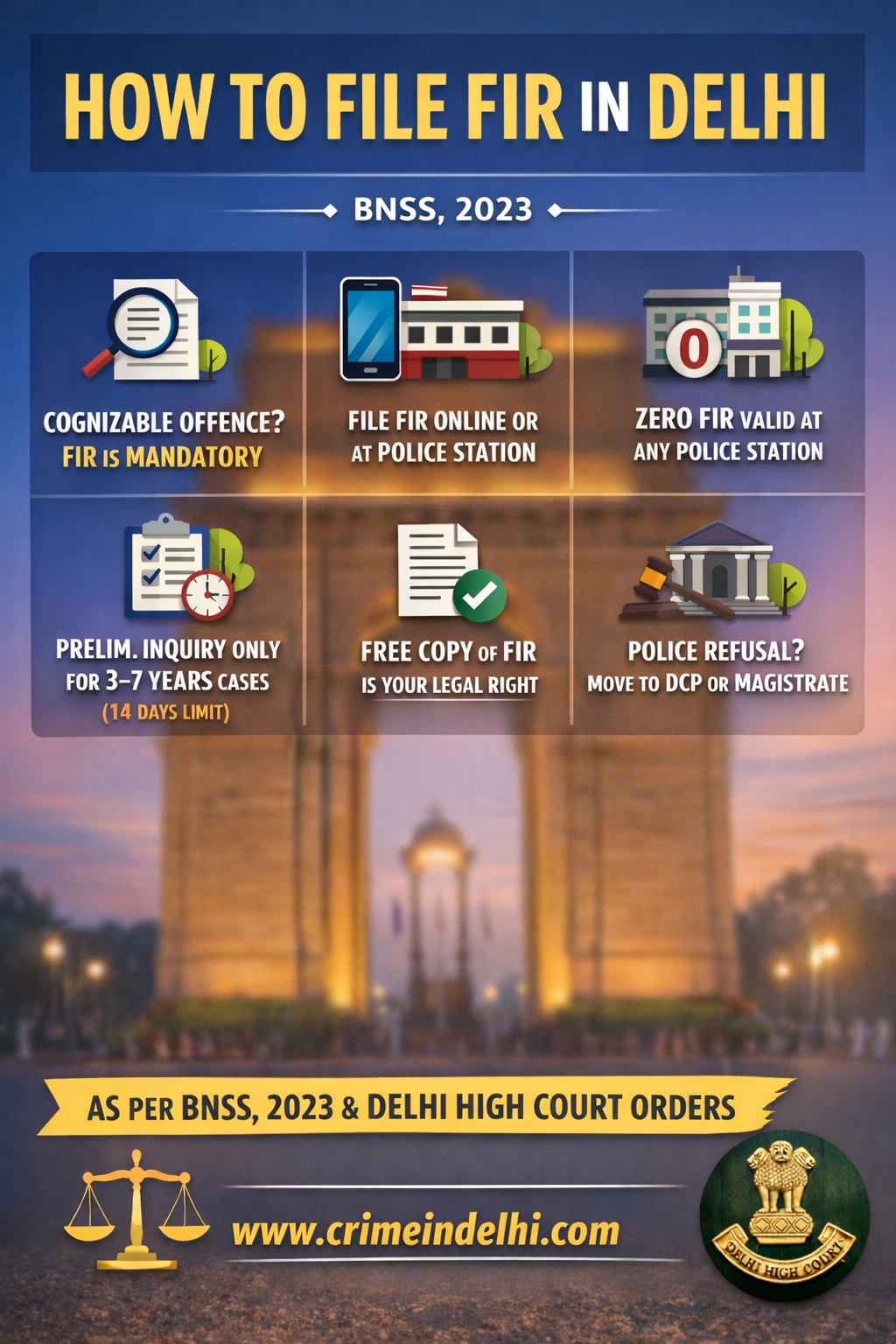
- Zero FIR and e‑FIR are expressly recognized. Information can be given orally or through electronic communication. If information is given electronically, it must be signed by the informant within 3 days for formal FIR registration.
FIR at police station (Delhi): Step‑by‑step Section 173(1), BNSS, 2023
- Go to any police station (Physical mode): You may approach any police station; Zero FIR can be registered irrespective of territorial jurisdiction and then transferred to the competent authority.
- Give information (oral or written): Narrate or submit a written complaint detailing the incident, date/time/place, accused (if known), and witnesses; the officer reduces oral information to writing and reads it over to you, which is signed by the informant.
- Ensure registration under section 173 BNSS: If the facts disclose a cognizable offence (e.g., theft, hurt, rape, cheating above threshold, etc.), the officer‑in‑charge must record it as FIR in CCTNS/Integrated Investigation.
- Sign and take a free copy: You must sign the recorded statement; a free copy of the FIR must be supplied to you.
- If SHO refuses: You may send the information in writing/electronically to the DCP/CP and seek directions, or move the Magistrate under section 173(4) read with section 175(3) BNSS (successor to section 156(3) CrPC) for an order directing registration and investigation.
e‑FIR / online FIR in Delhi: Step‑by‑step – section 173(1) proviso, BNSS, 2023
Use Delhi Police “Online Citizen Services” (CCTNS) or the e‑police station link for e‑FIR/complaints. FIRs for select categories (theft, lost documents, cyber offences, etc.) can be registered online. And for cyber offences: www.cybercrime.gov.in
- Choose appropriate service: Select “e‑FIR” or “File a complaint”; in Delhi, online FIR is presently available mainly for theft/motor vehicle theft and loss of documents/valuable articles, usually where accused is unknown or non‑special report cases.
- Fill details and submit: Provide incident particulars, place within Delhi, article/vehicle details, identity details and contact; submit and note the reference number/acknowledgment.
- Sign within 3 days: The BNSS mandates that electronically submitted information must be signed within 3 days by the informant, failing which it may not be treated as a valid FIR.
- Receive copy of e‑FIR: Once registered in CCTNS as FIR, you are entitled to a copy, usually downloadable from the portal or provided by the concerned police station.
Under the BNSS, electronic registration of FIR has statutory recognition.
Points to remember under BNSS for FIR registration
Cognizable vs non-cognizable: FIR is for cognizable offences. For offences punishable with imprisonment between 3 to 7 years, the police may conduct a preliminary inquiry before registering FIR. Such inquiry must be completed within 14 days. ‘Non-cognizable complaints are entered in a separate register and may require Magistrate’s order for investigation.’
Legal Basis: Section 173(3), BNSS, 2023, Case law: Lalita Kumari v. Govt. of U.P. (2014) — preliminary inquiry permitted only in limited categories.
Duty to register: Police are bound to register FIR where information discloses a cognizable offence; if police refuse to file the FIR, Complaint to Senior Police Officers, then submit written complaint to the DCP/ACP of the concerned district and also can file an application seeking directions to police for FIR registration under Section 173(4) and 175(3), BNSS, 2023.
Victim rights: The Victim has a right to get a free copy of FIR, to be informed about progress, and to approach higher police authorities or the court if registration is denied or the investigation is delay.
Zero FIR – Still Valid and Enforceable – A Zero FIR can be registered at any police station, irrespective of jurisdiction. It must later be transferred to the competent police station under Section 173(1), BNSS, 2023. The objective is to avoid delay and denial of justice.
Special directions for Women, Children & Vulnerable Persons: FIR relating to sexual offences must be recorded by a woman police officer. The statement may be recorded at the victim’s residence or place of choice. For persons with disabilities, recording through audio-video electronic means is mandatory.
Advice for Delhi Complainants for FIR
- Always mention exact date, time, place, and sequence of events.
- Carry supporting documents (screenshots, call records, medical reports).
- Obtain DD entry number if FIR is delayed.
- Preserve acknowledgment of online complaints.
Some relevant Delhi High Court judicial pronouncements that affirm legal principles relating to FIR registration, including when courts can direct registration and the limits on such directions.
The Delhi High Court in State of NCT of Delhi v. Puran Singh held that where a person dies in an encounter that is alleged to be fake, the FIR must be mandatorily registered if the material discloses suspicious circumstances requiring investigation. The Court reiterated that registration is to enable investigation, not to predetermine guilt or innocence, and refusal to register undermines the investigatory process.
In X v. State (NCT of Delhi) (2025), the Delhi High Court emphasised that where an offence occurs within territorial jurisdiction, a regular FIR must be recorded instead of a Zero FIR, especially if the procedural irregularity (such as reliance on Zero FIR) undermines the quality of investigation. The Court directed police to register the FIR in appropriate jurisdiction and transfer documents accordingly. Procedural compliance improves the integrity of investigation and evidence collection.
In Harmeet Singh v. State Govt. of NCT of Delhi, the Delhi High Court clarified that a magistrate does not have jurisdiction under Section 156(3) CrPC to direct a superior police officer (e.g., DCP) to register an FIR or oversee an investigation. The power is limited to ordering an investigation by the officer in charge of the police station.
A magistrate can direct an investigation but cannot command a higher-ranking officer to register an FIR.
In Kulvinder Singh Kohli v. State of NCT of Delhi, the High Court observed that police cannot issue summons under Section 160 CrPC (or its BNSS equivalent) without first registering FIR, because without FIR there is no formal investigation. This underscores the foundational role of FIR in criminal procedure. Investigation (including issuing summons) cannot proceed lawfully without FIR registration.
Preconditions for Magistrate to Direct FIR Registration
Delhi High Court emphasised that before directing FIR registration under Section 156(3) CrPC, a magistrate must carefully satisfy three pre-conditions:
- Disclosure of cognizable offence.
- Application of judicial mind.
- Speaking order indicating reasons to direct FIR registration.
The BNSS, 2023 has modernised FIR registration by introducing digital FIRs, mandating time-bound preliminary inquiry, and reinforcing the accountability of police officials.
However, the core principle of mandatory FIR registration for cognizable offences remains unchanged, as consistently upheld by the Supreme Court.