

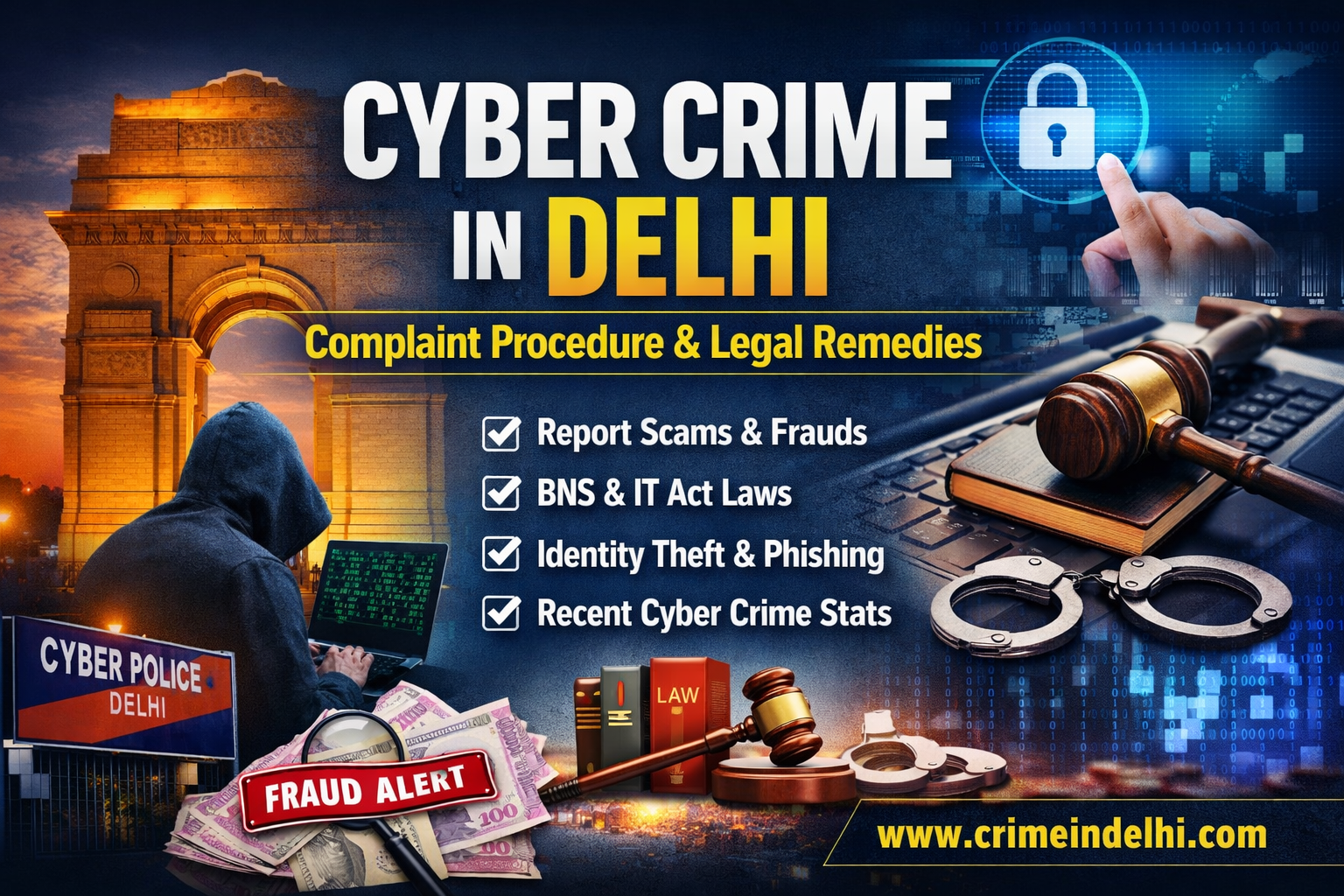
Cyber crime has emerged as one of the fastest-growing forms of crime in India, particularly in metropolitan cities like Delhi, where digital usage is high. From online financial fraud and identity theft to cyber harassment and phishing scams, cyber offences are affecting individuals, businesses, and institutions on a daily basis.
This article explains what constitutes cyber crime, how to file a cyber crime complaint in Delhi, and the legal remedies available under the Bharatiya Nyaya Sanhita (BNS), 2023, and the Information Technology Act, 2000, simply and practically.
What Is Cyber Crime?
Cyber crime refers to any unlawful act committed using a computer, mobile phone, internet, or digital network. The offence may be directed against a person, property, or the State and often involves misuse of electronic data or online platforms.
Common Types of Cyber Crime in Delhi
- Online financial fraud (UPI, credit card, OTP scams)
- Phishing and fake links
- Identity theft and impersonation
- Cyber stalking and online harassment
- Social media defamation
- Ransomware and hacking
- Fake job and investment scams
- “Digital arrest” scams targeting senior citizens
Cyber Crime Statistics: India & Delhi Latest
Cyber Crime Data in India (2023–2025)
- Total cyber crime cases (2023): 86,128
- Increase from 2022: 31.2% (65,893 cases in 2022)
- Major offences:
- Online financial fraud (largest share)
- Sexual exploitation
- Identity theft
- Cyber security incidents:
- 10.29 lakh (2022)
- 22.68 lakh (2024)
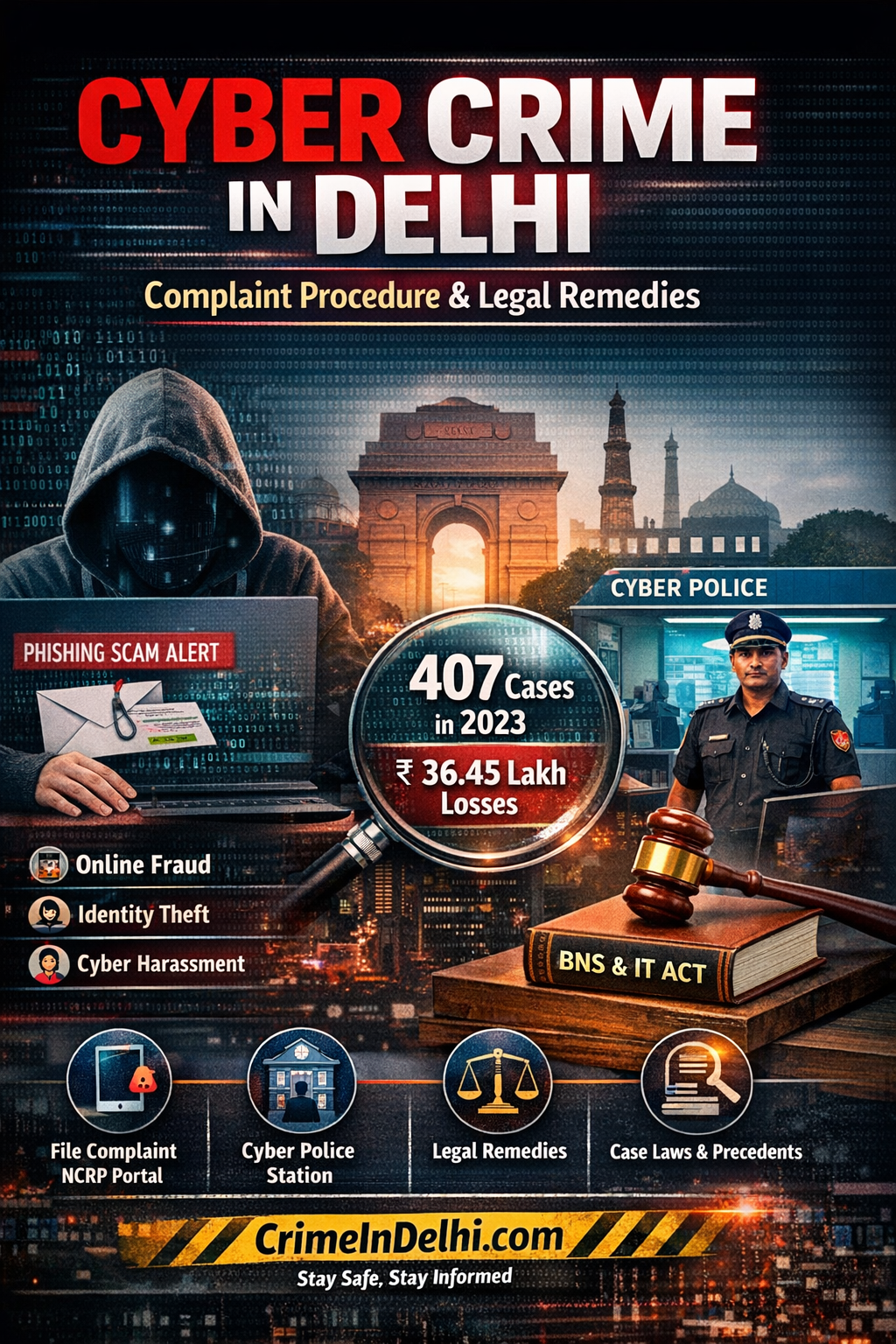
- Reported cyber fraud losses (Feb 2025): ₹36.45 lakh via NCRP
- Digital arrest scams: ₹23 crore siphoned off in just 47 days (2025)
What Is a ‘Digital Arrest’ Scam? – A New Cybercrime Pattern
Cyber Crime Data in Delhi
- Cases registered (2023): 407
- Cases registered (2022): 685
(The drop is widely believed to be due to under-reporting) - Financial losses (2020): Approx. ₹35 crore
- Risk profile: Delhi consistently ranks among the top cyber-crime-prone metropolitan cities
- Infrastructure support:
- National Cyber Forensic Laboratory, New Delhi
- Assisted in over 12,952 cases
- Preventive action:
- 11.14 lakh SIM cards blocked
- 2.96 lakh IMEI numbers blocked
Applicable Cyber Crime Laws in India
Cyber offences in Delhi are primarily governed by:
- Bharatiya Nyaya Sanhita (BNS), 2023 – Substantive criminal law
- Information Technology Act, 2000 – Special law for cyber offences
Key Cyber Crime Provisions Under BNS, 2023
-
Organized Cyber Crime – Section 111, BNS
This provision covers organized cyber offences committed by gangs or syndicates, including:
- Phishing rackets
- Ransomware attacks
- Botnet-based frauds
- Large-scale online scams
Punishment is severe, especially where financial loss or public harm is involved.
-
Electronic Forgery & Online Fraud – Section 336(1), BNS
Applies when a person:
- Creates or alters false electronic records
- Uses fake emails, websites, or digital documents
- Acts with intent to cheat or cause damage
Commonly used in fake job scams, forged emails, and online impersonation cases.
-
Identity Theft (BNS + IT Act)
While identity theft is specifically dealt with under the IT Act, the BNS strengthens prosecution where:
- Digital identity is misused
- Fake documents are uploaded or circulated
- Fraudulent digital representations are made
-
Cyber Defamation & Online Harassment – Section 356, BNS
Covers:
- Posting defamatory content online
- Social media abuse
- Online threats and harassment
- False allegations circulated digitally
Particularly relevant for social media crimes and influencer harassment cases.
-
Petty Organized Cyber Crime – Section 112, BNS
Targets small-scale but repeated cyber frauds, such as:
- ATM or card skimming
- Fake customer care calls
- Localized cyber gangs
Useful for prosecuting repeat offenders, even where individual amounts are small.
I4C–MHA और दिल्ली-एनसीआर पुलिस ने चलाया मेगा साइबरक्राइम अवेयरनेस कैम्पेन
Important Cyber Crime Case Laws in India
Courts have clarified how cybercrime offences are treated and how electronic evidence is admissible:
Shreya Singhal v. Union of India (2015) – Section 66A struck down; affirmed prosecution for genuine cyber offences like online harassment, fraud, and impersonation.
Suhas Katti Case (2004, TN) – First conviction under IT Act for cyber stalking and defamation.
Anvar P.V. v. P.K. Basheer (2014) – Electronic evidence admissible only with Section 65B certificate, critical for online fraud cases.
Arjun Panditrao Khotkar v. Kailash Gorantyal (2020) – Reinforced 65B certificate requirement for admissibility of digital records.
CBI v. Arif Azim (2003) – Online credit card fraud upheld, first major e-commerce conviction.
Umashankar Sivasubramanian v. ICICI Bank (2023) – Banks can be liable for failing to prevent cyber fraud, aiding victim compensation claims.
Relevance: These cases guide investigation, FIR drafting, bail arguments, and prosecution in Delhi cybercrime courts.
Important Cyber Crime Provisions Under the IT Act, 2000
- Section 43: Unauthorized access, data damage
- Section 66: Computer-related offences
- Section 66C: Identity theft
- Section 66D: Cheating by personation using computer resources
- Section 67: Publishing obscene content online
How to File a Cyber Crime Complaint in Delhi
Method 1: Online Complaint (Recommended)
- Visit National Cyber Crime Reporting Portal
- Choose:
- “Report Financial Fraud” OR
- “Report Other Cyber Crime”
- Enter details of:
- Incident
- Date and time
- Transaction / platform used
- Upload evidence:
- Screenshots
- Bank statements
- URLs, emails, phone numbers
- Submit and note the acknowledgment number
For financial frauds, report within the golden hour for better recovery chances.
Method 2: Offline Complaint in Delhi
- Visit the nearest Cyber Police Station
- Or approach the District Cyber Cell
- You may also file a complaint at the local police station, which is legally bound to register it.
Legal Remedies Available to Victims
- Registration of FIR under BNS + IT Act
- Freezing of bank accounts involved in fraud
- Blocking of SIM cards and IMEI numbers
- Digital forensic investigation
- Filing of compensation claims
- Criminal prosecution of accused persons
Practical Tips to Prevent Cyber Crime
- Never share OTPs or PINs
- Avoid clicking unknown links
- Verify customer care numbers
- Enable two-factor authentication
- Report suspicious activity immediately
Frequently Asked Questions (FAQs)
Q1. Can I file a cyber crime complaint without going to the police station?
Yes. You can file it entirely online through the National Cyber Crime Reporting Portal.
Q2. Is FIR mandatory in cyber crime cases?
Yes, for serious offences involving fraud, identity theft, or harassment, FIR registration is mandatory.
Q3. Which law applies now – IPC or BNS?
From 1 July 2024 onwards, Bharatiya Nyaya Sanhita (BNS), 2023 applies instead of IPC.
Q4. Can cyber crime money be recovered?
Recovery is possible if the complaint is filed promptly, especially in financial fraud cases.
Q5. Are cyber crimes bailable?
It depends on the offence, amount involved, and sections applied under BNS and IT Act.
Cyber crime in Delhi is a rapidly evolving threat that affects individuals, businesses, and institutions alike. With rising digital adoption, offences like online financial fraud, identity theft, cyber harassment, and phishing scams have become increasingly common. The Bharatiya Nyaya Sanhita (BNS), 2023, in conjunction with the Information Technology Act, 2000, provides a robust legal framework to tackle such offences, offering victims multiple avenues for complaint, investigation, and prosecution.
Awareness, prompt reporting, and preservation of digital evidence are crucial for safeguarding against cyber threats. Leveraging the NCRP portal, approaching cyber police stations, and understanding applicable legal provisions empower citizens to act decisively against cyber criminals.
By staying informed, practicing safe digital habits, and knowing the correct legal channels, Delhi residents can significantly reduce their vulnerability to cybercrime while contributing to a safer digital ecosystem.