
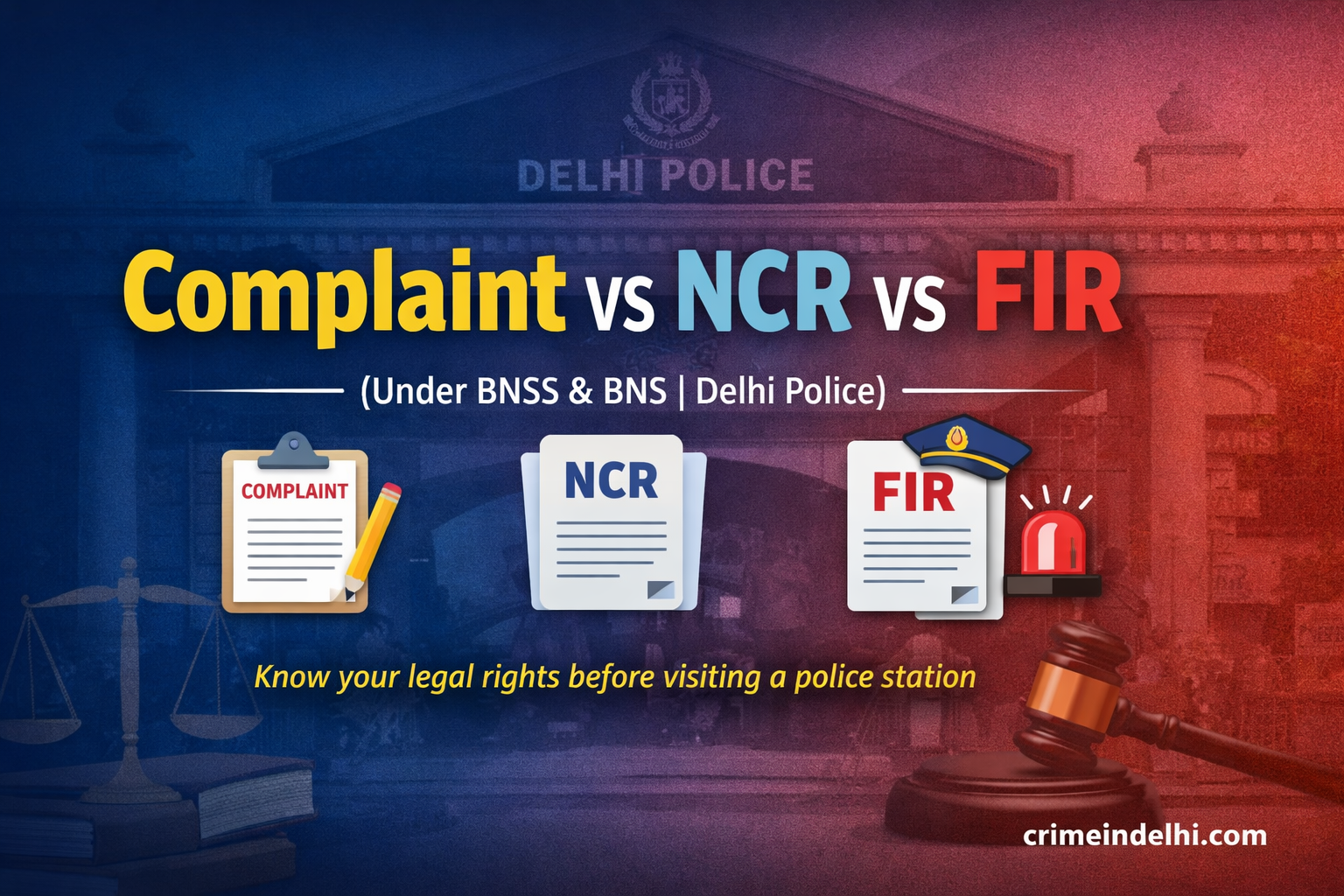
Understanding the difference between a Complaint, NCR (Non-Cognizable Report), and an FIR (First Information Report) is crucial for citizens approaching Delhi Police stations. With the coming into force of the Bharatiya Nagarik Suraksha Sanhita, 2023 (BNSS), which replaces the CrPC, and the Bharatiya Nyaya Sanhita, 2023 (BNS), which replaces the IPC, the legal framework has been modernised—but the foundational principles remain intact.
This article explains all concepts in simple language, while also covering legal provisions, Supreme Court judgments, and practical implications, especially in the context of the Delhi Police.
Delhi Police Crime Update
What is a Complaint?
In legal terms, a Complaint is any information given to the police or a Magistrate alleging that a person has committed an offence. It may relate to: Cognizable offences (serious crimes), or Non-cognizable offences (less serious matters).
Under BNSS, a complaint can be Oral or written, and given by the victim, witness, or any concerned person
Practical Understanding: A complaint is the first step where a citizen tells the police, “Something wrong has happened to me / I have information about a crime.” Not every complaint automatically becomes an FIR.
Some Examples of Complaints
- Neighbour dispute
- Verbal abuse
- Minor assault without serious injury
- Online fraud information awaiting verification
What is an NCR (Non-Cognizable Report)?
In legal terms, an NCR is a police record made when information discloses a non-cognizable offence, that is, an offence for which police cannot arrest or investigate without prior permission of a Magistrate.
Under BNSS, the police are required to:
- Record such information in the station diary / NCR register
- Inform the complainant about the remedy before the Magistrate
Practical Understanding: An NCR means “Police have noted your complaint, but the law does not permit immediate investigation without court approval.”
Some Examples of NCR Cases
- Minor hurt without serious injury
- Simple abuse or verbal altercation
- Defamation
- Public nuisance
- Minor property damage
What is an FIR?
In legal terms, an FIR (First Information Report) is a formal police record registered when information discloses the commission of a cognizable offence under BNS.
Under Section 173 BNSS, registration of FIR is mandatory where information reveals a cognizable offence.
Practical Understanding: An FIR means: “Police have officially accepted that a cognizable crime has occurred and investigation must start.”
Once FIR is registered:
- Investigation begins
- Police get statutory powers (search, seizure, arrest)
Some Examples of FIR Cases
- Theft, robbery, snatching
- Rape or sexual offences
- Kidnapping
- Serious assault
- Criminal intimidation with threat to life
Differences Between Complaint, NCR and FIR (With Statutory Provisions)
| Aspect | Complaint | NCR | FIR |
| Nature | Initial information | Formal non-cognizable record | Formal cognizable record |
| Applicable offences | Cognizable & Non-cognizable | Only non-cognizable | Only cognizable |
| Governing provision | BNSS (general information) | Section 174 BNSS | Section 173 BNSS |
| Police powers | Limited | No investigation without court order | Full investigation powers |
| Arrest | Not applicable | Not permitted without Magistrate order | Permitted as per BNSS |
| Investigation | Discretionary | Only with Magistrate approval | Mandatory |
| Substantive law | As per BNS | Minor offences under BNS | Serious offences under BNS |
| Legal consequence | Preliminary | Limited | Serious & enforceable |
Complaint, NCR, and FIR Under BNSS (New Law)
The Bharatiya Nagarik Suraksha Sanhita, 2023 (BNSS) strengthens procedural clarity, accountability, and citizen access to justice:
- Section 173 BNSS – Mandatory registration of FIR for cognizable offences
- Section 174 BNSS – Recording of information relating to non-cognizable offences (NCR)
- Section 175 BNSS – Power of Magistrate to order police investigation
- Section 176 BNSS – Procedure for police investigation
- Statutory recognition of Zero FIR and e-FIR
- Mandatory acknowledgement of complaints received by police
Despite procedural reforms, the legal distinction between complaint, NCR, and FIR remains intact.
Important Supreme Court Judgments
- Lalita Kumari v. Government of Uttar Pradesh (2014)
Landmark ruling holding that: FIR registration is mandatory for cognizable offences, and a preliminary inquiry is allowed only in limited categories.
- State of Haryana v. Bhajan Lal (1992)
Laid down categories where FIR can be quashed and prevent misuse of the criminal process.
- Priyanka Srivastava v. State of UP (2015)
A complaint before a magistrate must be supported by an affidavit and discourages false and motivated complaints.
- Youth Bar Association v. Union of India (2016)
An FIR copy must be supplied to the accused, and FIRs must be uploaded online (with exceptions).
Common Confusion Among Citizens
“Police Took My Complaint but Did Not Register FIR”
This usually happens when:
- Offence is non-cognizable
- Facts require verification
- Matter is civil in nature
“Complaint Register Ho Gayi, FIR Nahi”
A complaint entry (DD entry) is not equal to FIR.
What To Do If FIR Is Not Registered in Delhi?
Citizens have legal remedies:
- Approach the SHO of the police station
- Write to the DCP under BNSS provisions
- File an application before a Magistrate under Section 156(3) BNSS
- Approach the Delhi High Court in exceptional cases
Role of Zero FIR in Delhi
Zero FIR allows registration: At any police station, and Irrespective of territorial jurisdiction
This is especially important in Sexual offences and Crimes against women & children.
Arrest Is Now the Exception, Not the Rule
Complaint, NCR, FIR, and Misuse Safeguards
Courts consistently caution against: False FIRs and Weaponisation of criminal law.
BNSS strengthens safeguards through: Preliminary inquiry, Digital trail and Accountability of officers.
Few Real-Life Illustrations (Easy to Understand)
Illustration 1: Complaint Only
Ram visits a Delhi Police station and states that his neighbour, Shyam, abuses him verbally during frequent arguments. There is no physical injury or threat to life.
This information is treated as a complaint. Since the offence is minor and non-cognizable under BNS, police are not bound to register an FIR.
Illustration 2: NCR Registered
Sita reports that Mohan pushed her during a heated argument, causing no visible injury.
Police record an NCR under Section 174 BNSS. Investigation can commence only after obtaining permission from the Magistrate.
Illustration 3: FIR Mandatory
Ramesh reports that unknown persons snatched his mobile phone at knife-point while he was returning home.
This discloses a cognizable offence under BNS. Police must mandatorily register an FIR under Section 173 BNSS and begin an investigation.
Illustration 4: Zero FIR Situation
Anita is subjected to sexual assault in Gurugram but approaches a Delhi Police station to report the crime.
Police are legally required to register a Zero FIR, irrespective of territorial jurisdiction, and later transfer it to the appropriate police station.
In simple terms, a complaint is informing the police about a problem. NCR is recording a minor (non-cognizable) offence where police action needs court permission. FIR is the official start of a criminal investigation for serious offences
While every FIR begins with information, every complaint does not become an FIR, and many complaints result in an NCR. Under BNSS and BNS, the law carefully balances citizen rights, police authority, and judicial oversight to prevent misuse while ensuring access to justice.
For Delhi citizens, understanding this three-way distinction empowers them to assert their legal remedies effectively and lawfully.
Frequently Asked Questions (FAQs)
Q1. Is filing a complaint the same as registering an FIR?
No. Filing a complaint only means giving information to the police. An FIR is registered only when the information discloses a cognizable offence under BNS. Many complaints either remain as general complaints or are recorded as NCRs.
Q2. What is an NCR and why do police register it instead of an FIR?
An NCR (Non-Cognizable Report) is registered when the alleged offence is non-cognizable, meaning police cannot investigate or arrest without prior permission of a Magistrate. Police are legally bound to follow this procedure under BNSS.
Q3. Can police refuse to register an FIR in Delhi?
Police cannot refuse to register an FIR if the information clearly discloses a cognizable offence. This is settled law as per Lalita Kumari v. State of UP. However, for non-cognizable offences, police may lawfully register an NCR instead of an FIR.
Q4. What remedy does a citizen have if FIR is not registered?
A citizen may approach the SHO of the police station. File a written complaint before the DCP. Approach the Magistrate under Section 156(3) BNSS. And in rare cases, approach the High Court.
Q5. Can an NCR be converted into an FIR later?
Yes. If, during inquiry or based on additional facts, a cognizable offence is made out, the NCR can be converted into an FIR with proper legal procedure.
Q6. Is a Zero FIR different from an NCR?
Yes. A Zero FIR relates to cognizable offences and allows FIR registration irrespective of jurisdiction. An NCR relates only to non-cognizable offences and does not permit investigation without court approval.
Q7. Is online complaint or e-FIR legally valid?
Yes. Under BNSS and Delhi Police guidelines, online complaints and e-FIRs are legally recognised, subject to verification and statutory compliance.
Q8. Does registering an FIR mean the accused is guilty?
No. An FIR only sets the criminal law in motion. Guilt is determined solely by the court after trial, based on evidence.
What Happens After an FIR in Delhi – Investigation, Arrest & Bail Process
How to Register an FIR in Delhi
What to Do If Delhi Police Refuse to Register FIR
How to File an FIR in Delhi – via BNSS 2023
Checklist for Drafting a Bail Application in Delhi Courts
Disclaimer: This article is intended solely for general awareness and informational purposes and does not constitute legal advice. For case-specific guidance or legal action, readers are advised to consult a qualified advocate or the appropriate authorities.