
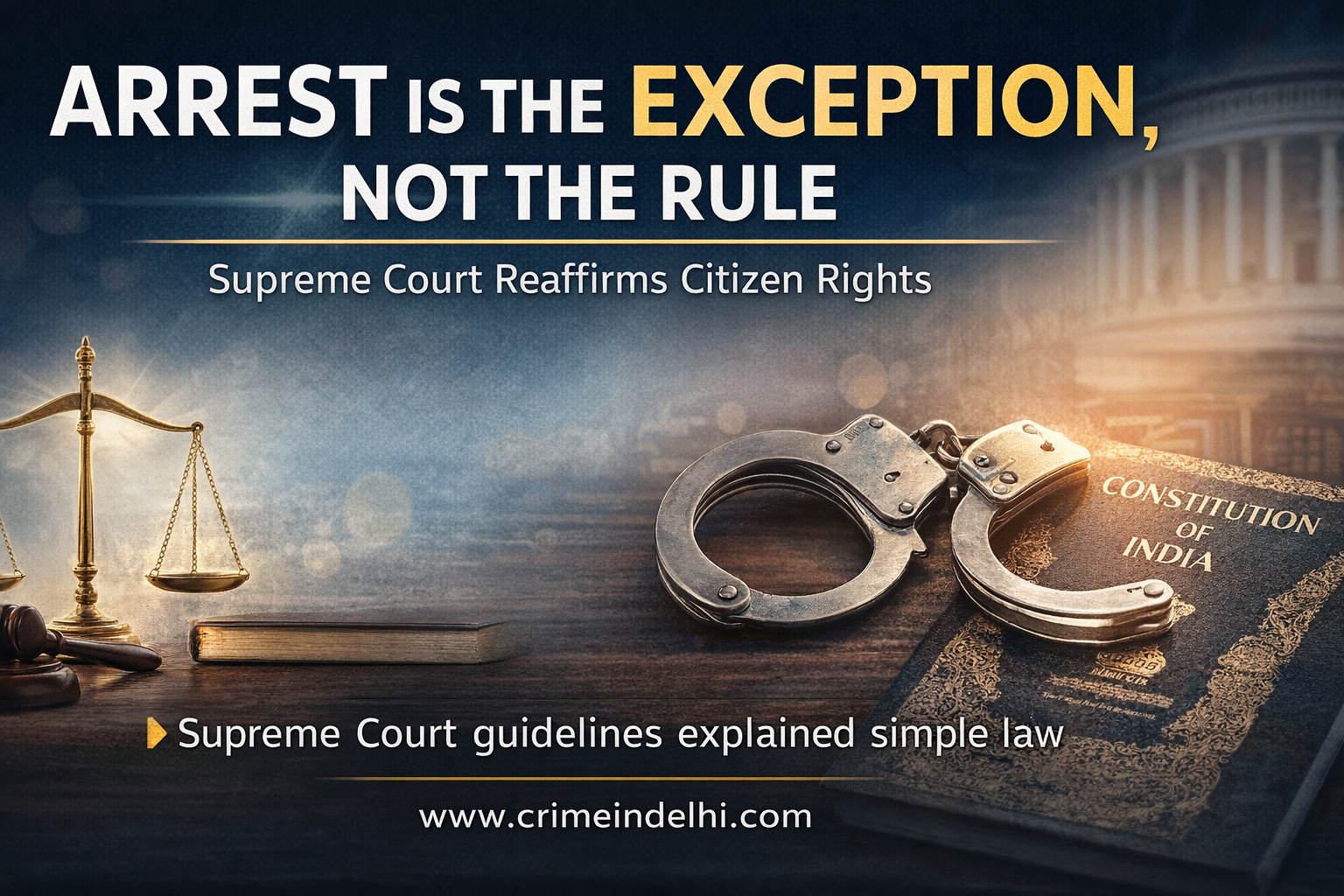
In a significant reaffirmation of personal liberty, the Supreme Court of India, while interpreting the Bharatiya Nagarik Suraksha Sanhita (BNSS), 2023, has made the legal position crystal clear:
Arrest is no longer the default action of the police — it is an exception, especially for offences punishable with imprisonment of up to seven years.
This development strengthens Article 21 of the Constitution, which guarantees the right to life and personal liberty, and ensures that police power is exercised with restraint, accountability, and reason.
Why This Change Matters to Ordinary Citizens
For years, arrest was often used as a routine step — sometimes even as a pressure tactic — in disputes involving:
-
Matrimonial conflicts
-
Financial or business disagreements
-
Property disputes
-
Minor criminal allegations
The Supreme Court has repeatedly warned that arrest causes humiliation, loss of dignity, and irreversible damage, even if the accused is later found innocent.
The BNSS now statutorily embeds this constitutional protection.
Section 35(3) BNSS: Notice Before Arrest Is Mandatory
Under Section 35(3) of the BNSS, the police must now follow a clear rule: If an offence is punishable with up to 7 years of imprisonment, the police must issue a Notice of Appearance instead of arresting the person immediately.
This notice requires the accused to: Appear before the investigating officer and Cooperate with the investigation
If the person complies, arrest should not be made.
In simple terms: Cooperation protects liberty.
Arrest Only When “Absolutely Necessary”
The Supreme Court has clarified that police must now ask a crucial question: Is arrest really necessary in this case? Arrest may be justified only when:
-
There is a real risk of the accused fleeing
-
Evidence is likely to be destroyed
-
Witnesses may be threatened
-
The accused may commit further offences
Mere suspicion or seriousness of allegations is not enough.
Reasons Must Be Recorded in Writing
Another critical safeguard is accountability.
If the police decide to arrest despite Section 35(3), they must:
-
Record specific reasons in writing
-
Explain why notice was insufficient
-
Show necessity, not convenience
Courts have made it clear that mechanical or routine arrests will not be protected.
Written Grounds of Arrest: A Supreme Court Mandate
In recent rulings, the Supreme Court has further strengthened safeguards by directing that:
-
Grounds of arrest must be given in writing
-
They must be explained in a language understood by the arrested person
-
Oral explanations alone are not sufficient
This applies irrespective of the nature of the offence.
Failure to provide written grounds can render the arrest illegal.
Role of Magistrates: No Automatic Remand
Judicial oversight is now central. Magistrates are duty-bound to:
-
Examine whether arrest was necessary
-
Verify compliance with Section 35(3) BNSS
-
Refuse remand if arrest is unlawful
A Magistrate cannot mechanically approve detention merely because the police ask for it.
From CrPC to BNSS: Continuity of Supreme Court Law
This framework builds upon the landmark judgment in: Arnesh Kumar v. State of Bihar (2014) 8 SCC 273
The Supreme Court held:
-
Arrest should not be automatic
-
Section 41A CrPC (notice of appearance) must be followed
-
Liberty cannot be sacrificed for convenience
The BNSS incorporates and strengthens these principles, making them harder to ignore.
When Arrest Is Still Permitted
Arrest remains a lawful tool in specific situations, such as:
✔ Serious Crimes
Offences punishable with: More than 7 years imprisonment, Life imprisonment, Death penalty.
✔ Non-Compliance
If the accused: Ignores or violates the Section 35(3) notice.
✔ Immediate Necessity
-
Hot pursuit
-
Caught red-handed
-
Imminent risk of escape or evidence destruction
Supreme Court’s Latest Warning (As of February 5, 2026)
The Supreme Court has reiterated and warned: Failure to follow the mandatory procedure under BNSS can make the arrest illegal, regardless of the offence.
Illegal arrests can result in:
Bail as a matter of right, Departmental action against police officers, Judicial censure.
What Citizens Should Remember
✔ Arrest is not punishment
✔ Liberty is the rule, detention is the exception
✔ Police power is subject to constitutional limits
✔ Courts will protect personal freedom
As consistently held by the Supreme Court: Law enforcement must be firm — but never arbitrary.
FAQs FOR CRIMEINDELHI READERS
1. Does this mean police cannot arrest anymore?
No. Police can still arrest, but only when necessary. Arrest is no longer automatic for offences punishable up to 7 years.
2. What is a Section 35(3) Notice under BNSS?
It is a written notice of appearance issued by police asking the accused to cooperate with investigation instead of arresting them immediately.
3. In which cases is this protection available?
For all cognisable offences punishable with imprisonment up to 7 years, unless exceptional circumstances exist.
4. If I receive a notice and cooperate, can I still be arrested?
Generally, NO. If you comply with the notice and cooperate, arrest should not be made unless there are strong reasons.
5. Can police arrest without giving reasons?
No. If police arrest, they must:
-
Record reasons in writing
-
Provide written grounds of arrest to the accused
Failure can make the arrest illegal.
6. What if police arrest me without notice?
Such an arrest can be:
-
Challenged before the Magistrate
-
Questioned as illegal
-
Grounds for bail and judicial relief
7. What is the role of the Magistrate now?
A Magistrate must independently examine whether:
-
Arrest was necessary
-
BNSS procedure was followed
Mechanical remand is not allowed.
8. Which Supreme Court case supports this?
The foundation comes from Arnesh Kumar v. State of Bihar (2014). Now strengthened and codified under BNSS, 2023.
9. Is this applicable in Delhi?
Yes. BNSS applies uniformly across India, including Delhi.
10. What should citizens remember?
✔ Arrest is an exception
✔ Cooperation protects liberty
✔ Law is on the side of personal freedom