
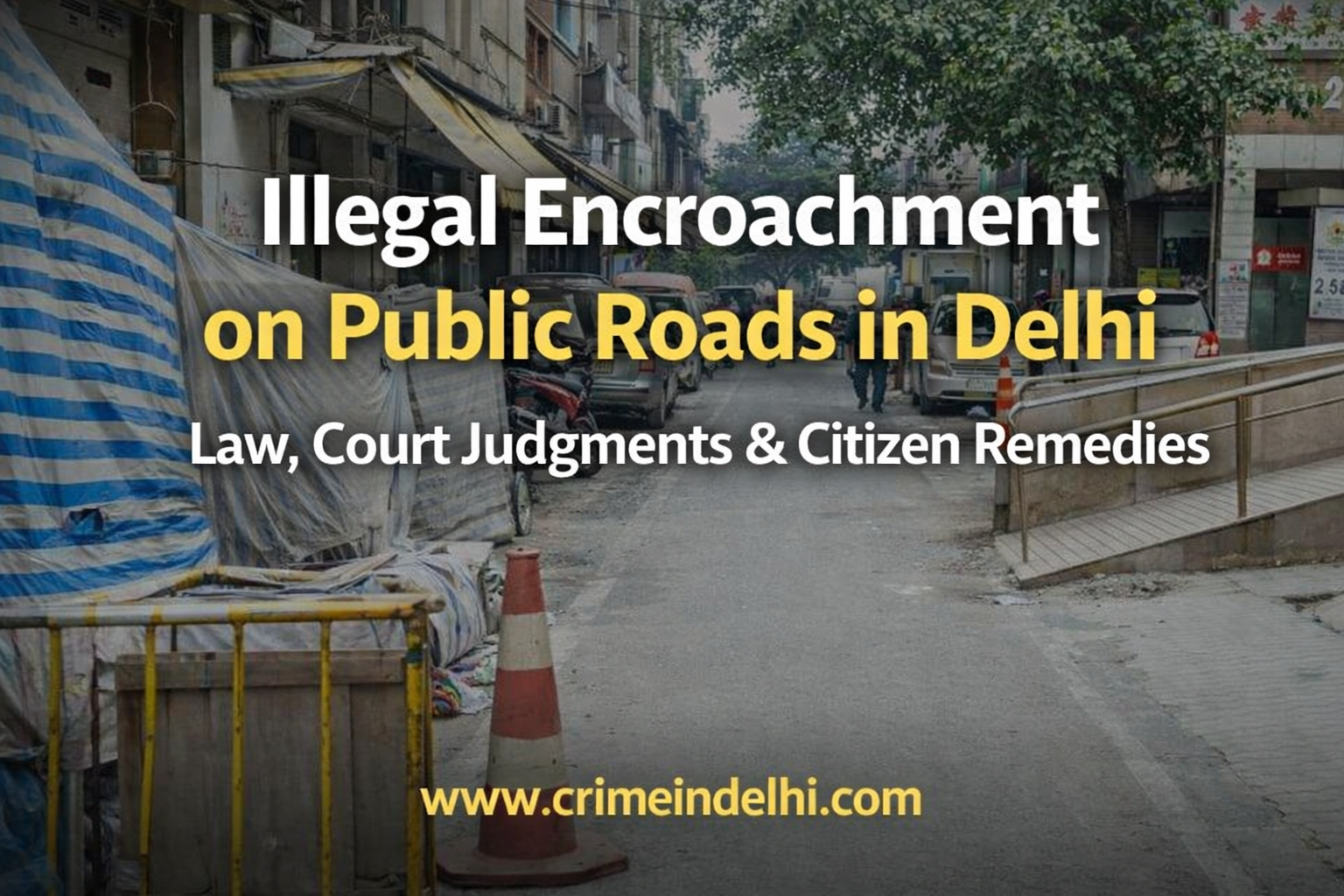
Delhi’s public roads, service lanes, and footpaths are increasingly under siege from illegal encroachments by commercial establishments, hospitals, builders, and shop owners. What begins as a temporary obstruction often becomes a permanent structure, choking traffic, blocking emergency access, and violating citizens’ constitutional right to free movement.
Indian courts have repeatedly held that public land is held in trust by the State, and no private entity—however influential—can appropriate it for commercial gain.
This article explains:
- What constitutes illegal encroachment
- The legal framework in Delhi
- Landmark Supreme Court and Delhi High Court rulings
- Real examples from Delhi
- Practical remedies available to citizens
What Is Illegal Encroachment on Public Roads?
Illegal encroachment includes:
- Construction on service lanes or road-widening areas
- Use of public land for parking, waiting lounges, ramps, gates, kiosks
- Extending buildings beyond the sanctioned building plan
- Blocking footpaths and access routes
Even if the main building is authorized, any construction beyond the sanctioned plan is illegal.
Legal Framework Governing Road Encroachments in Delhi
-
Delhi Municipal Corporation Act, 1957
- Section 321 / 322 – Action against unauthorized construction
- Section 343 – Demolition of illegal structures
- Section 345-A – Sealing of premises
- Section 298 – Removal of encroachments from streets
-
Section 133 CrPC/152 BNSS – Public Nuisance
Empowers the SDM to order the immediate removal of obstruction from public ways.
-
Delhi Land Revenue Act
Protects government land from illegal occupation.
-
Sanctioned Building Plans & PWD Norms
Anything beyond the sanctioned plan is per se illegal, irrespective of ownership claims.
Landmark Case Laws on Encroachment
-
Jagpal Singh v. State of Punjab (2011) 11 SCC 396
“No person can claim equity or adverse possession over public land.”
The Supreme Court directed removal of all encroachments on public land, regardless of duration.
-
M.C. Mehta v. Union of India (2006) 3 SCC 399
The Court emphasized that public roads and streets must remain free for public use and cannot be sacrificed for private interests.
-
Ajay Maken v. Union of India (2019, Delhi HC)
Delhi High Court held:
Unauthorized occupation of public land does not create any legal right.
-
Municipal Corporation of Greater Mumbai v. Sunbeam High Tech Developers (2019) 5 SCC 55
Courts must not protect illegal constructions under interim orders.
-
Olga Tellis v. Bombay Municipal Corporation (1985) 3 SCC 545
Even while balancing rights, the Court held that public streets cannot be permanently occupied.
Examples of Encroachment Cases from Delhi
Various Hospitals Encroachment on Service Lane
Public roads in Delhi are being illegally occupied by hospitals and shops. Learn what the law says, key court rulings, and how citizens can act.
Karol Bagh & Lajpat Nagar Markets
Commercial establishments extended:
- Ramps
- Parking structures
- Temporary sheds onto footpaths and service lanes, later demolished by MCD after court intervention.
Shahdara & Rohini Zones
Repeated sealing drives for:
- Unauthorized commercial use
- Encroachment on roads abutting residential plots
Why Courts Refuse Stay Orders in Encroachment Cases
Courts consistently refuse interim protection because:
- No prima facie right exists in illegality
- Balance of convenience lies with the public
- Encroachers approach courts after prolonged violations
- Granting stay legitimizes unlawful conduct
What Can Citizens Do Against Encroachment?
- File complaint with MCD / SDM / PWD
- Approach Public Grievances Commission (PGC), Delhi
- Use RTI to track enforcement
- File Writ Petition (Mandamus) in Delhi High Court
- Seek action under Section 133 CrPC
Encroachment on public roads is not a minor civic issue—it is a systemic violation of public trust. The law is settled, the courts are firm, and the remedies are effective. What is required is citizen awareness and consistent enforcement.
Public roads are meant for the public—not for private expansion.
Frequently Asked Questions (FAQs)
1. Is it legal for hospitals to use footpaths or service lanes for ramps or parking?
No. Hospitals cannot occupy footpaths, service lanes, or public roads, even for ramps, ambulance access, or parking. Any construction beyond the sanctioned building plan is illegal.
2. What if the hospital says the encroachment is “temporary” or for emergencies?
The law does not recognise temporary encroachment on public land. Courts have repeatedly held that public roads must remain free at all times, including during emergencies.
3. Can a commercial shop extend its frontage onto the footpath?
No. Footpaths are meant exclusively for pedestrians. Extending shops, placing display boards, stairs, or platforms on footpaths is illegal.
4. If an encroachment has existed for many years, does it become legal?
No. Long usage does not create any legal right. The Supreme Court has clearly ruled that no equity arises from illegality, even if authorities earlier failed to act.
5. Can courts grant a stay on demolition of illegal encroachments?
Generally, no. Courts consistently refuse to protect illegal constructions and have held that no injunction can be granted in favour of an encroacher.
6. Who can take action against road encroachments in Delhi?
Multiple authorities can act, including:
-
Municipal Corporation of Delhi (MCD)
-
Sub-Divisional Magistrate (SDM)
-
Public Works Department (PWD)
-
Delhi Police (for obstruction and public nuisance)
7. What legal remedy does a citizen have if authorities don’t act?
Citizens can:
-
File a complaint before the SDM under Section 133 CrPC
-
Approach the Public Grievances Commission (PGC), Delhi
-
File an RTI to track enforcement
-
File a writ petition (mandamus) before the Delhi High Court
8. Do hospitals or big businesses get special protection under law?
No. Courts have clearly stated that social utility or business importance does not justify encroachment on public land.
9. Is encroachment a violation of constitutional rights?
Yes. Blocking roads and footpaths violates Article 19(1)(d) — the right to free movement of citizens.
10. Can citizens complain even if the encroachment affects only their street?
Yes. Encroachment on any public road or footpath is a public nuisance, and any affected citizen can raise the issue.